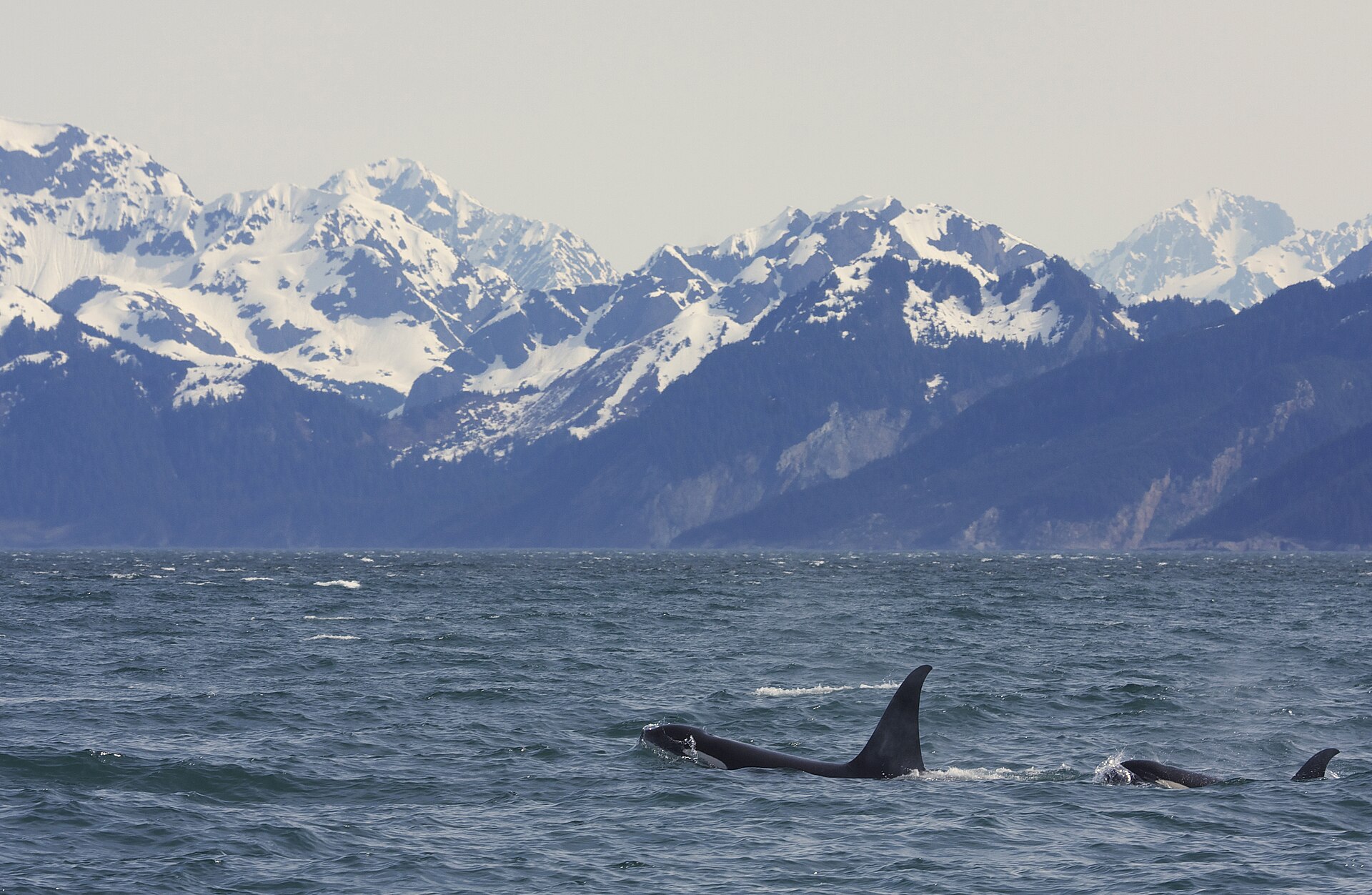
Strangers in a Strange Land - 3 unidentified Orcas spotted in Vancouver Harbour

Status
Not open for further replies.
.
Lmao
The gun up in Johnstone Strait?? wasn't put there to "shoot at killer whales" and it wasn't a machine gun to boot!
I'm not sure what gun you're referring to. I'm talking about the .50 cal that DFO mounted by Seymour Narrows in 1960 or 1961. Dr. John Ford (one of the pioneers of killer whale research in BC with dozens of hours on the water; not sure of his halibut credentials) talks about it here: https://www.castanet.net/news/BC/124199/Machine-gun-for-killer-whales

Edit: a bit more history here https://thetyee.ca/Life/2008/05/13/... end, the fishermen,and hated along the coast.
 
Last edited:
Some nice photos and an update on T419, T420, and T421 from yesterday.

Most interesting is the report that they’re apparently associating with some of our local Ts. It’d be very cool to get a biopsy or a scat sample from these new visitors to see how related they are to known west coast Ts. None of our west coast Ts have cookie cutter bites that I know of and it’s also rare to have interactions between populations; there’s usually indifference, avoidance, or on rare occasions aggression when different populations cross paths.

Goes to show that there’s always more to learn.

 
"...it’s also rare to have interactions between populations; there’s usually indifference, avoidance, or on rare occasions aggression when different populations cross paths."

While that may be generally true, it stands to reason that occasionally, when meeting, in an instinctual need to reinvigorate the gene pool, a mating occurrence could happen. There's much we do not know.
 
"...it’s also rare to have interactions between populations; there’s usually indifference, avoidance, or on rare occasions aggression when different populations cross paths."

While that may be generally true, it stands to reason that occasionally, when meeting, in an instinctual need to reinvigorate the gene pool, a mating occurrence could happen. There's much we do not know.
Genetically speaking there's ~350,000 - 700,000 years of divergence between Bigg's and resident/fish eaters, with the North Pacific residents being more closely related to Atlantic fish eaters than they are to the Bigg's that they share the same waters with.

Deeper dive on killer whale genetics here: https://royalsocietypublishing.org/...ised-taxonomy-of-eastern-North-Pacific-killer

There's far less information telling the difference between the mammal-eating populations in the North Pacific which is why these "new" animals, with their presumed origins from a different mammal-eating population than the west coast Bigg's (presumed origin based on the presence of CC bites), mixing it up with known west coast Bigg's is particularly interesting.

There's much we do not know and there's always more to learn. Sounds like we're on the same page! Speaking of pages, here are links to catalogues of some of the various mammal eaters in the Eastern North Pacific.

Catalogue of Gulf of AK Ts (some CC bites): https://www.whalesalaska.org/_files/ugd/d07eba_7329bc107ad24bc4bcce66e42e56c882.pdf

Catalogue of West Coast Ts (no CC bites): https://www.researchgate.net/publication/398258949_Photo-identification_Catalogue_and_Status_of_the_Coastal_Subset_of_the_West_Coast_Transient_Population_of_Bigg's_Killer_Whale_in_British_Columbia_Canada

Catalogue of Outer Coast Ts (the OCX group has CC bites): https://repository.library.noaa.gov/view/noaa/30740

Edit: we know from captive animals that the various ecotypes can interbreed and produce viable offspring.

 
Last edited:
"...it’s also rare to have interactions between populations; there’s usually indifference, avoidance, or on rare occasions aggression when different populations cross paths."

While that may be generally true, it stands to reason that occasionally, when meeting, in an instinctual need to reinvigorate the gene pool, a mating occurrence could happen. There's much we do not know.
This^^
Super pods have been seen many times over the yrs, I've witnessed one myself up in Discovery Passage
 
Not really. The important distinction is that super pods are the same population mixing! For example, a bunch of SRKW or NRKW or a T party could be a super pod (and a super pod generally refers to specific social behavior when whales meet and mix up, not just whales traveling together).

However, you’re not going to see mixing between different populations. That behavior is not supported by over 50 years of observation in the wild nor is it supported by the genetic evidence. Edit: this is why the new group mixing with the known group is exciting. The whales obviously know more than we do about each other.

Edit: one might think that Bigg’s, being mammal eaters, are the tough ones but in the couple of observations where they have interacted with SRKW, the SRKW give them the business. Strength in numbers, presumably, and/or perhaps an example of “mobbing” behavior shown by other critters flushing potential predators out of the area.
 
Last edited:
Genetically speaking there's ~350,000 - 700,000 years of divergence between Bigg's and resident/fish eaters, with the North Pacific residents being more closely related to Atlantic fish eaters than they are to the Bigg's that they share the same waters with.

Deeper dive on killer whale genetics here: https://royalsocietypublishing.org/...ised-taxonomy-of-eastern-North-Pacific-killer

There's far less information telling the difference between the mammal-eating populations in the North Pacific which is why these "new" animals, with their presumed origins from a different mammal-eating population than the west coast Bigg's (presumed origin based on the presence of CC bites), mixing it up with known west coast Bigg's is particularly interesting.

There's much we do not know and there's always more to learn. Sounds like we're on the same page! Speaking of pages, here are links to catalogues of some of the various mammal eaters in the Eastern North Pacific.

Catalogue of Gulf of AK Ts (some CC bites): https://www.whalesalaska.org/_files/ugd/d07eba_7329bc107ad24bc4bcce66e42e56c882.pdf

Catalogue of West Coast Ts (no CC bites): https://www.researchgate.net/publication/398258949_Photo-identification_Catalogue_and_Status_of_the_Coastal_Subset_of_the_West_Coast_Transient_Population_of_Bigg's_Killer_Whale_in_British_Columbia_Canada

Catalogue of Outer Coast Ts (the OCX group has CC bites): https://repository.library.noaa.gov/view/noaa/30740

Edit: we know from captive animals that the various ecotypes can interbreed and produce viable offspring.
Is there any chance at all that these visitors might convince the picky eater locals to just try a taste of seal?
 
Is there any chance at all that these visitors might convince the picky eater locals to just try a taste of seal?
Per the west coast T catalogue that I linked: there were 571 mammal eaters alive in BC in 2024 and their population is growing at about 4% a year. So there are already more mammal eaters than fish eaters in BC.

Unfortunately there’s little chance of our local fish eaters swapping to seals. It’s not zero - there are some fish eaters in the North Atlantic that do prey switch to seals on occasion - but it’s not known when or why that began.

There are a lot of other things we can do to try and recover the amount of fish besides managing natural predators but managing natural predators has usually been the easy scapegoat option.
 
Per the west coast T catalogue that I linked: there were 571 mammal eaters alive in BC in 2024 and their population is growing at about 4% a year. So there are already more mammal eaters than fish eaters in BC.

Unfortunately there’s little chance of our local fish eaters swapping to seals. It’s not zero - there are some fish eaters in the North Atlantic that do prey switch to seals on occasion - but it’s not known when or why that began.

There are a lot of other things we can do to try and recover the amount of fish besides managing natural predators but managing natural predators has usually been the easy scapegoat option.
Little chance? Have you read this article?

 
Psychologically trapped 😂 those are the most free creatures this world has to offer.
Free doesn't necessarily mean perfect.

There are plenty of examples of "free" whales making mistakes, stranding, getting trapped, and/or dying outside of their normal habitats. Here are just a few to take or leave.

Dyes Inlet 19: https://www.pugetsoundinstitute.org/wp-content/uploads/2023/01/Timeline.pdf

Coffman Cove, AK (x2!): https://www.fisheries.noaa.gov/feat...dents-help-free-two-killer-whales-barnes-lake

Beluga in Puget Sound (maybe the same one that later died in the Gulf of California?): https://www.newsweek.com/beluga-wha...inlet-orca-network-washington-seattle-1636499
Little chance? Have you read this article?


Yep. Little chance. The paper you're referencing is on fish-eating whales seasonally eating different species of fish. That's not new behavior and has been documented many times for fish-eaters in the North Pacific. Here are a couple more papers showing the same thing: https://journals.plos.org/plosone/a...iNFvYCDxIxCZj_6-Pib6-j1__BLnC4Gw14530Cu-kbONs.


None of fish eaters are switching to eating mammals, as @sly_karma was hoping for. They do occasionally harass and kill juvenile harbour porpoise and seals, but not at a rate that will make any difference to the population.

Edit: here are two papers on the North Atlantic killer whales prey switching from fish to mammals and back.


What's more interesting is this study on some mammal-eaters in the Aleutians occasionally eating squid!
 
Last edited:
Status
Not open for further replies.
Back
Top