Strangers in a Strange Land - 3 unidentified Orcas spotted in Vancouver Harbour

Status
Not open for further replies.
Per the west coast T catalogue that I linked: there were 571 mammal eaters alive in BC in 2024 and their population is growing at about 4% a year. So there are already more mammal eaters than fish eaters in BC.

Unfortunately there’s little chance of our local fish eaters swapping to seals. It’s not zero - there are some fish eaters in the North Atlantic that do prey switch to seals on occasion - but it’s not known when or why that began.

There are a lot of other things we can do to try and recover the amount of fish besides managing natural predators but managing natural predators has usually been the easy scapegoat option.
I struggle to understand this. I get the rationale for favouring chinook over other salmon species: caloric density. The smaller fish barely provide enough energy to replace that consumed in chasing and catching them. Online reading says adult chinook yield about 700 calories/lb and of course they have more pounds than the other salmon species. But seal blubber can contain as much as 4000 calories/lb (probably a lower figure down here in the mild south), and of course seals weigh far more than chinook salmon. One good sized adult seal would provide a day's calories for an orca, it's more calories in and fewer out because fewer hunts.

The mammal-eating orcas have figured it out. Why don't the fish eaters turn to seals when chinook abundance is down? I know we can't get alongside and interview them, but what clues does science have? One of the key features we assign as a marker of intelligence in animal species is ability to adapt to varying conditions and availability of food. Are we off the mark with orcas, or is there something else going on? Being fixated on a specific food source even when other sources are available seems counter to evolutionary survival. What am I missing here?
 
I struggle to understand this. I get the rationale for favouring chinook over other salmon species: caloric density. The smaller fish barely provide enough energy to replace that consumed in chasing and catching them. Online reading says adult chinook yield about 700 calories/lb and of course they have more pounds than the other salmon species. But seal blubber can contain as much as 4000 calories/lb (probably a lower figure down here in the mild south), and of course seals weigh far more than chinook salmon. One good sized adult seal would provide a day's calories for an orca, it's more calories in and fewer out because fewer hunts.

The mammal-eating orcas have figured it out. Why don't the fish eaters turn to seals when chinook abundance is down? I know we can't get alongside and interview them, but what clues does science have? One of the key features we assign as a marker of intelligence in animal species is ability to adapt to varying conditions and availability of food. Are we off the mark with orcas, or is there something else going on? Being fixated on a specific food source even when other sources are available seems counter to evolutionary survival. What am I missing here?
I think you'd see similar levels of mouth-breathing in most cousin loving populations.
 
I struggle to understand this. I get the rationale for favouring chinook over other salmon species: caloric density. The smaller fish barely provide enough energy to replace that consumed in chasing and catching them. Online reading says adult chinook yield about 700 calories/lb and of course they have more pounds than the other salmon species. But seal blubber can contain as much as 4000 calories/lb (probably a lower figure down here in the mild south), and of course seals weigh far more than chinook salmon. One good sized adult seal would provide a day's calories for an orca, it's more calories in and fewer out because fewer hunts.

The mammal-eating orcas have figured it out. Why don't the fish eaters turn to seals when chinook abundance is down? I know we can't get alongside and interview them, but what clues does science have? One of the key features we assign as a marker of intelligence in animal species is ability to adapt to varying conditions and availability of food. Are we off the mark with orcas, or is there something else going on? Being fixated on a specific food source even when other sources are available seems counter to evolutionary survival. What am I missing here?
There are some great questions here! I'll try to answer them with the caveats that 1. I'm not an expert 2. I'm not a great science educator 3. given some of the posts in this thread I'm not sure this is a receptive audience. I'll do my best to provide links where I can so you can get more information presented better than I'm able to. There are a lot of factors that are at play here and a deep dive (ahem) into all of them would be "publishing your Ph.D" level writing, not a "sportfishingbc" post.

I'll attempt to paraphrase part of your question to "What clues does science have to explain why fish eaters don't turn to seals when chinook abundance is down?"

In environmental science/ecology, there are "generalists" and there are "specialists". Generalists are easily adaptable to changing environments while specialists are finely tuned to specific environments and don't handle change well. Further reading on generalists vs. specialists: NG link Albert.io link Fuse School video

A local example of a generalist would be a glaucous winged gull. These birds are able to thrive everywhere from downtown Vancouver where they'll eat french fries and fentanyl needles to the most pristine areas of the BC coast where they'll eat herring, crabs, and other natural prey items. Put a strip mall on Cape Scott and the gulls that live there will switch from herring to french fries in a day.

A marbled murrelet would be an example of a specialist; they require specific feeding and breeding areas to survive. Log the old growth that they need to breed and they're unable to move to other habitats.

In undisturbed environments where resources are not limited, critters can afford to be specialists without too much risk. Advantages to specialization include being able to exploit specific niches that others can't, therefore removing competition.

Looking back to some of the KW reference material that I've already linked to, you will see that genetic studies show that Bigg's and "resident" (fish eaters) are separated by ~350,000 - 700,000 years of evolution, and up until recently (before west coast colonization/industrialization) there was no problem to be specialized as a fish eater or a mammal eater because there was plenty of both to go around and neither population was directly competing with each other. EDIT: and back in the day when chinook were abundant and huge (~100 pounders in the Elwha?), the cost-per-chase differential wasn't that big of a deal. Salmon used to be bigger, but not so much anymore, which is a bummer.

Once disturbance comes into play the specialists will begin to suffer. So, once the ecosystem around here started to see the effects of industrialization (clear cutting, dams, overfishing, urbanization, habitat loss, etc. all of which took place in the last ~150 years or so) the specialists can't adapt fast enough. Keep in mind killer whales have about the same lifespan as humans, so ~150 years is only a few generations. That's not long to undo half a million years (+-) of evolution.

"One of the key features we assign as a marker of intelligence in animal species is ability to adapt to varying conditions and availability of food. Are we off the mark with orcas, or is there something else going on?"

There's zero question that killer whales are highly intelligent. Don't take my word for it, there are many examples of how intelligent they are. The cultural differences are especially important to take into account. Captive mammal eaters have learned to eat fish (or die), and captive animals from different populations have learned each other's dialects and can mate and produce viable offspring. But in the wild those sorts of shifts don't happen. You're born into your ecotype and you'll die your ecotype.

You mention "The mammal-eating orcas have it figured out" but they're just the lucky specialists in this case, and it wasn't necessarily always this way. When KW studies began in the 70s, there were only a few dozen known mammal-eaters on the BC coast, while there were approximately 300 in the SRKW and NRKW populations. Keep in mind pinnipeds were subjected to serious culling efforts in BC and elsewhere, with the harbour seal population in the early 1970s being estimated at fewer than 10,000 animals and Steller sea lions fewer than 4000 animals. That's not a lot to sustain a population of Bigg's. But once culling stopped and the harbour seal and SSL population started to rebound, it's not surprising that Bigg's population followed. The NRKW population, which generally lives in more remote, less disturbed areas of WA, BC, and SE AK, also seems to be doing much better than the more urban SRKW. We don't have the luxury of knowing how many Bigg's or resident types there were before human disturbance but it's likely that there were more of both types.

"Being fixated on a specific food source even when other sources are available seems counter to evolutionary survival. What am I missing here?"

What I think you're missing here is that you're applying a human timescale, where we've radically altered the environment in an extremely short amount of time, to an evolutionary process that's taken our local killer whale populations hundreds of thousands of years to get to. They can't evolutionally turn on a dime.

Long story long (again) I'll try to summarize here:

"What clues does science have to explain why fish eaters don't turn to seals when chinook abundance is down?"

Our local killer whale populations evolved to be specialists and can't just switch food sources on a whim. Their specialization is literally baked into their DNA.

"One of the key features we assign as a marker of intelligence in animal species is ability to adapt to varying conditions and availability of food. Are we off the mark with orcas, or is there something else going on?"

We're not off the mark but we have to try to understand and apply killer whale intelligence in the context of their evolution and environment, not our expectation.

"Being fixated on a specific food source even when other sources are available seems counter to evolutionary survival. What am I missing here?"

Human disturbance timescale vs. evolutionary timescale.

Hopefully this helps!

 
Last edited:
There are some great questions here! I'll try to answer them with the caveats that 1. I'm not an expert 2. I'm not a great science educator 3. given some of the posts in this thread I'm not sure this is a receptive audience. I'll do my best to provide links where I can so you can get more information presented better than I'm able to. There are a lot of factors that are at play here and a deep dive (ahem) into all of them would be "publishing your Ph.D" level writing, not a "sportfishingbc" post.

I'll attempt to paraphrase part of your question to "What clues does science have to explain why fish eaters don't turn to seals when chinook abundance is down?"

In environmental science/ecology, there are "generalists" and there are "specialists". Generalists are easily adaptable to changing environments while specialists are finely tuned to specific environments and don't handle change well. Further reading on generalists vs. specialists: NG link Albert.io link Fuse School video

A local example of a generalist would be a glaucous winged gull. These birds are able to thrive everywhere from downtown Vancouver where they'll eat french fries and fentanyl needles to the most pristine areas of the BC coast where they'll eat herring, crabs, and other natural prey items. Put a strip mall on Cape Scott and the gulls that live there will switch from herring to french fries in a day.

A marbled murrelet would be an example of a specialist; they require specific feeding and breeding areas to survive. Log the old growth that they need to breed and they're unable to move to other habitats.

In undisturbed environments where resources are not limited, critters can afford to be specialists without too much risk. Advantages to specialization include being able to exploit specific niches that others can't, therefore removing competition.

Looking back to some of the KW reference material that I've already linked to, you will see that genetic studies show that Bigg's and "resident" (fish eaters) are separated by ~350,000 - 700,000 years of evolution, and up until recently (before west coast colonization/industrialization) there was no problem to be specialized as a fish eater or a mammal eater because there was plenty of both to go around and neither population was directly competing with each other. EDIT: and back in the day when chinook were abundant and huge (~100 pounders in the Elwha?), the cost-per-chase differential wasn't that big of a deal. Salmon used to be bigger, but not so much anymore, which is a bummer.

Once disturbance comes into play the specialists will begin to suffer. So, once the ecosystem around here started to see the effects of industrialization (clear cutting, dams, overfishing, urbanization, habitat loss, etc. all of which took place in the last ~150 years or so) the specialists can't adapt fast enough. Keep in mind killer whales have about the same lifespan as humans, so ~150 years is only a few generations. That's not long to undo half a million years (+-) of evolution.

"One of the key features we assign as a marker of intelligence in animal species is ability to adapt to varying conditions and availability of food. Are we off the mark with orcas, or is there something else going on?"

There's zero question that killer whales are highly intelligent. Don't take my word for it, there are many examples of how intelligent they are. The cultural differences are especially important to take into account. Captive mammal eaters have learned to eat fish (or die), and captive animals from different populations have learned each other's dialects and can mate and produce viable offspring. But in the wild those sorts of shifts don't happen. You're born into your ecotype and you'll die your ecotype.

You mention "The mammal-eating orcas have it figured out" but they're just the lucky specialists in this case, and it wasn't necessarily always this way. When KW studies began in the 70s, there were only a few dozen known mammal-eaters on the BC coast, while there were approximately 300 in the SRKW and NRKW populations. Keep in mind pinnipeds were subjected to serious culling efforts in BC and elsewhere, with the harbour seal population in the early 1970s being estimated at fewer than 10,000 animals and Steller sea lions fewer than 4000 animals. That's not a lot to sustain a population of Bigg's. But once culling stopped and the harbour seal and SSL population started to rebound, it's not surprising that Bigg's population followed. The NRKW population, which generally lives in more remote, less disturbed areas of WA, BC, and SE AK, also seems to be doing much better than the more urban SRKW. We don't have the luxury of knowing how many Bigg's or resident types there were before human disturbance but it's likely that there were more of both types.

"Being fixated on a specific food source even when other sources are available seems counter to evolutionary survival. What am I missing here?"

What I think you're missing here is that you're applying a human timescale, where we've radically altered the environment in an extremely short amount of time, to an evolutionary process that's taken our local killer whale populations hundreds of thousands of years to get to. They can't evolutionally turn on a dime.

Long story long (again) I'll try to summarize here:

"What clues does science have to explain why fish eaters don't turn to seals when chinook abundance is down?"

Our local killer whale populations evolved to be specialists and can't just switch food sources on a whim. Their specialization is literally baked into their DNA.

"One of the key features we assign as a marker of intelligence in animal species is ability to adapt to varying conditions and availability of food. Are we off the mark with orcas, or is there something else going on?"

We're not off the mark but we have to try to understand and apply killer whale intelligence in the context of their evolution and environment, not our expectation.

"Being fixated on a specific food source even when other sources are available seems counter to evolutionary survival. What am I missing here?"

Human disturbance timescale vs. evolutionary timescale.

Hopefully this helps!
Does this guy know how to party, or what?!
 
Thanks for so much effort, it does help.

"One of the key features we assign as a marker of intelligence in animal species is ability to adapt to varying conditions and availability of food. Are we off the mark with orcas, or is there something else going on?"

There's zero question that killer whales are highly intelligent. Don't take my word for it, there are many examples of how intelligent they are. The cultural differences are especially important to take into account. Captive mammal eaters have learned to eat fish (or die), and captive animals from different populations have learned each other's dialects and can mate and produce viable offspring. But in the wild those sorts of shifts don't happen. You're born into your ecotype and you'll die your ecotype.
Sorry for sloppy composition here. What I should have said was, "Are we off the mark by equating adaptability with intelligence?" No argument from me that orcas are highly intelligent.

What I think you're missing here is that you're applying a human timescale, where we've radically altered the environment in an extremely short amount of time, to an evolutionary process that's taken our local killer whale populations hundreds of thousands of years to get to. They can't evolutionally turn on a dime.

Our local killer whale populations evolved to be specialists and can't just switch food sources on a whim. Their specialization is literally baked into their DNA.
So there's my answer. Applying a human outlook doesn't provide any insight. There are reasons for the specialization, but at this point... it just is.
 
Thanks for so much effort, it does help.


Sorry for sloppy composition here. What I should have said was, "Are we off the mark by equating adaptability with intelligence?" No argument from me that orcas are highly intelligent.


So there's my answer. Applying a human outlook doesn't provide any insight. There are reasons for the specialization, but at this point... it just is.
Glad I could help. I've been at this killer whale science party for 30 years so it's nice to be able to share some of what I've learned.

Adaptability is certainly a desirable trait in rapidly changing systems. For killer whales that trait didn't matter until relatively recently.

If humans were judged by killer whale intelligence standards (whatever they may be) I'm pretty sure we'd fail. I mean we can barely swim, let alone echolocate. ;)

And yes, I suppose they just "are" at this point. Given that we're the ones making the rapid changes, I think the onus is on us, as humans, to understand and hopefully minimize our impact on the natural world vs. expecting the natural world to accommodate our whims.
 
One other thing re. the proposed regulations keeping vessels 200m from Bigg’s and 1000m from SRKW is that those numbers would be equivalent to the regs in Washington. I guess there’s something to be said about consistency across the border if nothing else.
 
One other thing re. the proposed regulations keeping vessels 200m from Bigg’s and 1000m from SRKW is that those numbers would be equivalent to the regs in Washington. I guess there’s something to be said about consistency across the border if nothing else.
Consistency in regs is fine, meaningful enforcement is what's needed. Most members on here have seen flagrant breaches by the whale watching boats.
 
One other thing re. the proposed regulations keeping vessels 200m from Bigg’s and 1000m from SRKW is that those numbers would be equivalent to the regs in Washington. I guess there’s something to be said about consistency across the border if nothing else.
At 1000M for SRKW, I’m pretty sure the business model for the whale watching industry is done. You can only show your clients so many seals on rocks before the clients are gonna go this is a ripoff. Maybe that’s the master plan by DFO. Kill another industry.
 
Consistency in regs is fine, meaningful enforcement is what's needed. Most members on here have seen flagrant breaches by the whale watching boats.
Whale watching boats play by different rules, I think their distance restrictions are half that of everyone else. They are "specially trained".
 
Whale watching boats play by different rules, I think their distance restrictions are half that of everyone else. They are "specially trained".
they bring "observers"
Somehow misinformation gets out and is perpetuated. Hopefully I can help set the record straight.

WW boats are under the same rules as everyone else. They also operate under a microscope of govt observation and public opinion. Most ww companies in the Salish Sea are members of the Pacific Whale Watch Association. https://www.pacificwhalewatchassociation.com/regulations

The outcome of this case could have huge implications for the industry in BC.


I spent a lot of time on the Soundwatch boat in the 90s and early 00s where we monitored vessel traffic and behavior around whales. By and large the biggest offenders were Joe Public who were often so obtuse they wouldn’t even slow down when running through a stopped fleet of brightly coloured ww boats. We’d stop them and hand out information and they’d say “I didn’t even notice…” or something like that. Ugh.

Due to the common and perpetuated misconceptions (as seen here in this thread) and high profile of their operations, every ww operator I know does their best to not break any rules. Nobody wants a lawsuit to shut down their business or the entire industry.

Edit: added Soundwatch link
 
Last edited:
At 1000M for SRKW, I’m pretty sure the business model for the whale watching industry is done. You can only show your clients so many seals on rocks before the clients are gonna go this is a ripoff. Maybe that’s the master plan by DFO. Kill another industry.
There are plenty of Bigg’s and humpbacks and other wildlife for wildlife tours to watch. SRKW aren’t regular enough visitors to rely on anymore and nobody’s going to risk their business by watching them when they’re around. It’s been this way in the ww industry for years now.
 
There are plenty of Bigg’s and humpbacks and other wildlife for wildlife tours to watch. SRKW aren’t regular enough visitors to rely on anymore and nobody’s going to risk their business by watching them when they’re around. It’s been this way in the ww industry for years now.
I'm So Old I remember when WW operators made a face and acted disappointed when they spotted Transients-bloodthirstly sonsofbitches that they are.

How times have changed......
 
I'm So Old I remember when WW operators made a face and acted disappointed when they spotted Transients-bloodthirstly sonsofbitches that they are.

How times have changed......
That was around the same time when there were no humpbacks to watch at all!

Edit: I’m curious and I figure this crowd would probably know - has any private boater or fisher been prosecuted for harassing a marine mammal in BC recently?
 
Somehow misinformation gets out and is perpetuated. Hopefully I can help set the record straight.

WW boats are under the same rules as everyone else. They also operate under a microscope of govt observation and public opinion. Most ww companies in the Salish Sea are members of the Pacific Whale Watch Association. https://www.pacificwhalewatchassociation.com/regulations

The outcome of this case could have huge implications for the industry in BC.


I spent a lot of time on the Soundwatch boat in the 90s and early 00s where we monitored vessel traffic and behavior around whales. By and large the biggest offenders were Joe Public who were often so obtuse they wouldn’t even slow down when running through a stopped fleet of brightly coloured ww boats. We’d stop them and hand out information and they’d say “I didn’t even notice…” or something like that. Ugh.

Due to the common and perpetuated misconceptions (as seen here in this thread) and high profile of their operations, every ww operator I know does their best to not break any rules. Nobody wants a lawsuit to shut down their business or the entire industry.

Edit: added Soundwatch link
I was told that by a group of first Nations people in a boat as they thought we were too close in our skiff pulling traps in Saanich Inlet. I guess things have changed.
 
I was told that by a group of first Nations people in a boat as they thought we were too close in our skiff pulling traps in Saanich Inlet. I guess things have changed.

Things haven’t changed; the First Nations folks were also misinformed. The only folks that are allowed to approach closely are researchers under permit.
And the Whales get “Psychologically trapped”.
Here we go again. Shrug.
 
they bring "observers"

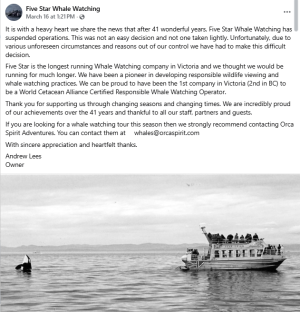
yes and I read that's why that 5 star whale watching shut down its business that two of its main biologist retired and the company's operations increasingly relied on a rotating team of student biologists and naturalists from the University of Victoria.

1773943289390.png
 
Last edited:
yes and I read that's why that 5 star whale watching shut down its business that two of its main biologist retired and the company's operations increasingly relied on a rotating team of student biologists and naturalists from the University of Victoria.
Of course every operation is going to have naturalists on board. Some even have “dozens of hours” of experience! ;) You wouldn’t take a fishing charter without a knowledgeable captain and crew, would you?

Unless you have a permit, no amount of onboard expertise - not even a halibut commissioner - allows a vessel to shirk the regs.
 
Status
Not open for further replies.
Back
Top