
B
bones
Guest
There's a map for the acoustic locations if you need it

Well - you sure are predictable - if nothing else, bones.Lol there called local stock...... Could you answer the question?
to "Lol there called local stock" - meanwhile ignoring both the links and questions I posted wrt why they are looking at lice on smolts in the Broughtons - and while we are at it - ignoring the obvious risk and evidence of other impacts like disease transfer....smolts DO NOT TRAVEL THROUGH THE BROUGHTON.
Nice try Bones my post at #452 was refering to the videos you posted dated 2010,11 and 12. The above info states what they did after 2015 to address the fact that there were NONE between Array H (Northern Straight of Georgia) and I (Queen Charlotte Straight) as I indicated to you at post #475. LolAs part of the SSMSP, PSF has enhanced the use of acoustic tags and receivers within the Strait of Georgia. Until 2015, the existing acoustic receiver arrays allowed for fish detections in the lower Fraser River, in Juan de Fuca Strait, in north-central Strait of Georgia (NSoG), and in northern Queen Charlotte Strait only. While these arrays have been very useful, they could not provide sufficient resolution to assess the residence time; migration patterns, rate and timing; and survival of juvenile Pacific salmon within the Strait of Georgia.
To address these issues, PSF deployed 43 new acoustic VR4 receivers in the Discovery Islands (northern end of the Strait of Georgia/Salish Sea) and Johnstone Strait near Sayward, BC in 2015. 41 of these were loaned from OTN and the other two were loaned from Kintama. These are all dual array receivers and can pick up both 69KHz and 180KHz frequencies, which are emitted by larger Vemco V7 tags (69 kHz) and new V4 (180 kHz) tags, respectively. The V4 tag is half the size of the V7 and weighs only 0.24 gm in water. The smaller tag is preferred for juvenile salmon but the cost of this development is a reduced range of signal detection at 180 kHz.
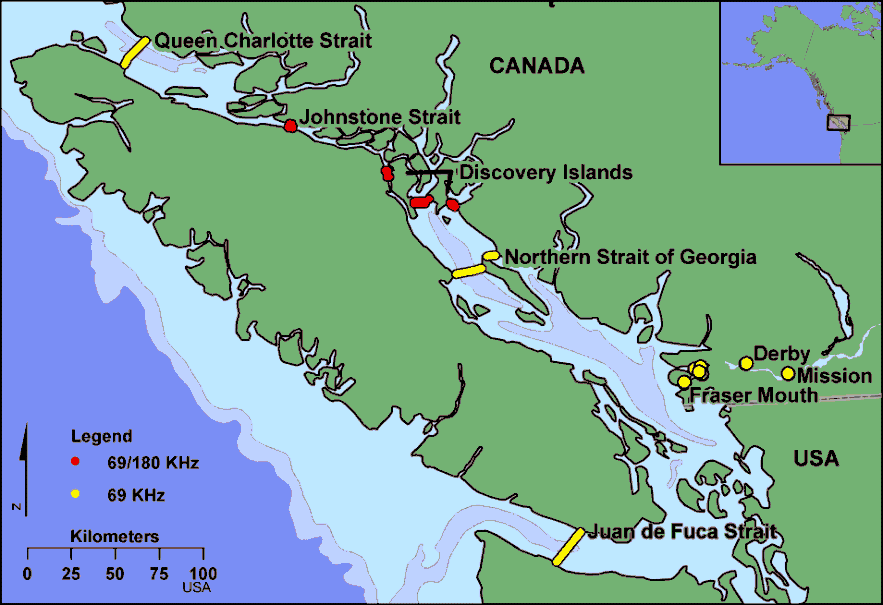
The locations for deployment have been mapped by Kintama Research and are shown below.
The red coloured arrays in the figure above are those arrays implemented by KIntama Research and are additional to the arrays managed by the Ocean Tracking Network (OTN)- coloured yellow. The red-coloured arrays in the Discovery Islands are 69 and 180KHz and can detect the new small and high frequency V4 tags in addition to larger tags.
These locations allow us to unambiguously measure individual juvenile fish migration rate, residence time and survival by specific areas within the Salish Sea and Discovery Islands. Calculation of survival rates requires a receiver array seaward of a tagging location and/or a previous array (i.e., the QCI array enables estimates of survival of tagged fish that pass over the new Johnstone Strait array and then are detected at the QCI array). The information on salmon migration behavior and survival provides direct evidence that can support other studies that infer residence times or survival based on observational studies.

As part of the SSMSP, PSF has enhanced the use of acoustic tags and receivers within the Strait of Georgia. Until 2015, the existing acoustic receiver arrays allowed for fish detections in the lower Fraser River, in Juan de Fuca Strait, in north-central Strait of Georgia (NSoG), and in northern Queen Charlotte Strait only. While these arrays have been very useful, they could not provide sufficient resolution to assess the residence time; migration patterns, rate and timing; and survival of juvenile Pacific salmon within the Strait of Georgia.
To address these issues, PSF deployed 43 new acoustic VR4 receivers in the Discovery Islands (northern end of the Strait of Georgia/Salish Sea) and Johnstone Strait near Sayward, BC in 2015. 41 of these were loaned from OTN and the other two were loaned from Kintama. These are all dual array receivers and can pick up both 69KHz and 180KHz frequencies, which are emitted by larger Vemco V7 tags (69 kHz) and new V4 (180 kHz) tags, respectively. The V4 tag is half the size of the V7 and weighs only 0.24 gm in water. The smaller tag is preferred for juvenile salmon but the cost of this development is a reduced range of signal detection at 180 kHz.
The locations for deployment have been mapped by Kintama Research and are shown below.
The red coloured arrays in the figure above are those arrays implemented by KIntama Research and are additional to the arrays managed by the Ocean Tracking Network (OTN)- coloured yellow. The red-coloured arrays in the Discovery Islands are 69 and 180KHz and can detect the new small and high frequency V4 tags in addition to larger tags.
These locations allow us to unambiguously measure individual juvenile fish migration rate, residence time and survival by specific areas within the Salish Sea and Discovery Islands. Calculation of survival rates requires a receiver array seaward of a tagging location and/or a previous array (i.e., the QCI array enables estimates of survival of tagged fish that pass over the new Johnstone Strait array and then are detected at the QCI array). The information on salmon migration behavior and survival provides direct evidence that can support other studies that infer residence times or survival based on observational studies.
They passed the top of Texada and were recorded as doing so they did not make it passed the Lice infested Fish Farms so were not recorded at the Queen Charlotte Straights.Just answer one question AA? I posted it above and many times over. You keep dodging by picking apart what I say. This I why you only post link to studies its so you cant get picked apart. Could you answer the question? I've asked many times.....
Why did they die at the top of texada,
It's called accountability, bones - it's what should happen in say - and environmental review - that the open net-pen industry has unfortunately successfully avoided through collusion and corruption. I post the link - so you and any other interested posters can look it up. That's what the peer-review process is about - checks in accountability....You keep dodging by picking apart what I say. This I why you only post link to studies its so you cant get picked apart.
Weell, bones - if you had truly been looking at the data - even from the Kintama videos you posted - you would also have seen the video that GLG posted on where the fish disappear - mostly after the Discovery Islands - as far as marine mortality. I think it is both logical and responsible to assume that some of that extra mortality may well have been from impacts from either the fish farms in either the Discovery Islands and/or the Broughtons (i.e. in Johnson Strait to Queen Charlotte Sound). It certainly does not support your unfortunately naive view (IMHO) that FFs have no impacts on wild stocks.Does it really matter, it shows smolt migration thru Johnson strait which is what I said. If you need more information you could just look up the paper. Why did they die at the top of texada, look up the blooms thru 2014-2016 or 2017 if you have seen the latest release on the salish sea.
Just answer one question AA? I posted it above and many times over. You keep dodging by picking apart what I say. This I why you only post link to studies its so you cant get picked apart. Could you answer the question? I've asked many times..... .
You didnt look hard enoughHad a look at your questions from JUST FROM THIS MORNING.
Which question are you wanting answered?
You are right Bonesfunny game..... if fish farms kill or are responsible for killing wild stocks then why is it that everyone has moved on?

I
I take it you had no rebutle to my post about the hites study so you responded with the usual diatribe where you claim to represent all the forum members blah blah bla. Typical.
Second question. What stocks and salmon runs are being effected by fish farms?
What stock are effected by fish farms and how much damage to inventories? Would you care to explain or answer there question? Or are you going to spin this again?
so.... 7.8 million Chinook smolts are being eat by predators, believe that is a 2017 test results,,,, so not new. again how many smolts do fish farms kill? what runs are they influencing?...........well?You are right Bones
Time to move on
Nothing new coming from you.
Did you not read the report I posted? Here let me help you.....so.... 7.8 million Chinook smolts are being eat by predators, believe that is a 2017 test results,,,, so not new. again how many smolts do fish farms kill? what runs are they influencing?...........well?
so.... 7.8 million Chinook smolts are being eat by predators, believe that is a 2017 test results,,,, so not new. again how many smolts do fish farms kill? what runs are they influencing?...........well?


