
Are you suggesting that those lice were planted by AI?Show us the unedited video of
a net going into the ocean and coming out of the ocean with that smolt with all those lice on it and you may garner more people to your side of the argument, until then its very hard, bordering on impossible to believe its real

You are using an out of date browser. It may not display this or other websites correctly.
You should upgrade or use an alternative browser.
You should upgrade or use an alternative browser.
Aquaculture improving?..The Fish Farm Thread
- Thread starter islandboy
- Start date
wildmanyeah
Crew Member
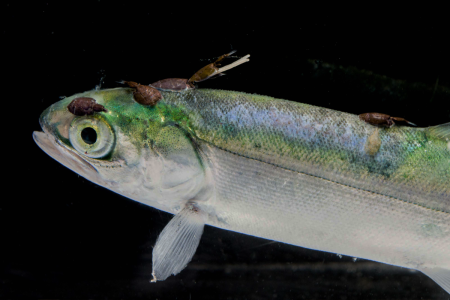
like this chum carrying 200 sea lice
Extraordinary claims require extraordinary evidence
“….In various stages of development” I can count roughly a hundred on the side in the picture and likely the other side will be the same. Real pictures don’t lie.Extraordinary claims require extraordinary evidence
Doubt is the commodity sold by the PR firms employed by the industry; & individuals within both DFO Stock Assistance & the ONPSF industry find it hard to admit they are part of a industry that has real-life impacts to wild salmon as most of those employees (with a few exceptions) are generally well-intended folks. Those well-intended folks usually suffer from cognitive dissonance and try to find a way to discount reality that conflicts with their beliefs; while the PR firms & the DFO comms branch get paid to lie. Money seems to overcome any doubts they have.Are you suggesting that those lice were planted by AI?
WRT that pic - seeing lice on a wild outmigrating smolt is not "extraordinary", but the sheer number of lice might be.
From what I can tell by looking at a 2D pic of a 3D container - it looks like a larger (~90+ mm) Chinook smolt to me that has turned his/her caudal fin up & to the left while swimming - it's doesn't look quite as "eroded" to me as it appears, but the bottom corner could be. The scales are missing off the top back end of the smolt - where most of the motile lice are eating the scales off the body of the smolt. The so-termed trailing "erosion" of said fins looks more like trailing mucus. Fish produce more quantities of mucus when they are stressed - and both capture & the motile lice are stressors.
I can easily identify ~40 motile pre-adult stages of lice on one side - and the earlier, darker lice are most probably Leps; while the later settled pinkish ones on the front are more likely Caligus. W/o magnification - it is difficult to spot the Chalmus & copepod stages - that are usually more numerous than the preadult stages because not all of them survive to the later stages of development.
So, yes this poor fish could have ~100 lice on each side or ~200 lice in total of all species & stages. One has to look at the developmental rate of the sea lice to infer when & possibly where these lice loadings happened.
It's a dead fish swimming as the numbers of (motile) lice per gram of fish that can cause mortality are in the range of 0.7 – 1.6 lice per gram of fish - dependent upon study, species & life history stage of the lice.

Why Are B.C. Salmon Farms Hiding Their Lice Numbers?
B.C. salmon farms are pulling back lice reporting, raising risks for wild salmon and reducing public transparency.
 watershedwatch.ca

SpringFever2359
Well-Known Member
NopeAre you suggesting that those lice were planted by AI?
Lice could have easily been put in the container same way as they dropped the smolt in, maybe even a person placing lice on the smolt before putting in that container, not putting it past any anti anything to do what they think is necessary to shut down whatever they are protesting,
never heard this saying?!
always 3 sides to a story, side 1 and then side 2, then there's side 3 the truth!
Last edited:
SpringFever2359
Well-Known Member
Wrong again aa, I have zero skin in the game, not a paid anti flunky like some,Doubt is the commodity sold by the PR firms employed by the industry; & individuals within both DFO Stock Assistance & the ONPSF industry find it hard to admit they are part of a industry that has real-life impacts to wild salmon as most of those employees (with a few exceptions) are generally well-intended folks. Those well-intended folks usually suffer from cognitive dissonance and try to find a way to discount reality that conflicts with their beliefs; while the PR firms & the DFO comms branch get paid to lie. Money seems to overcome any doubts they have.
WRT that pic - seeing lice on a wild outmigrating smolt is not "extraordinary", but the sheer number of lice might be.
From what I can tell by looking at a 2D pic of a 3D container - it looks like a larger (~90+ mm) Chinook smolt to me that has turned his/her caudal fin up & to the left while swimming - it's doesn't look quite as "eroded" to me as it appears, but the bottom corner could be. The scales are missing off the top back end of the smolt - where most of the motile lice are eating the scales off the body of the smolt. The so-termed trailing "erosion" of said fins looks more like trailing mucus. Fish produce more quantities of mucus when they are stressed - and both capture & the motile lice are stressors.
I can easily identify ~40 motile pre-adult stages of lice on one side - and the earlier, darker lice are most probably Leps; while the later settled pinkish ones on the front are more likely Caligus. W/o magnification - it is difficult to spot the Chalmus & copepod stages - that are usually more numerous than the preadult stages because not all of them survive to the later stages of development.
So, yes this poor fish could have ~100 lice on each side or ~200 lice in total of all species & stages. One has to look at the developmental rate of the sea lice to infer when & possibly where these lice loadings happened.
It's a dead fish swimming as the numbers of (motile) lice per gram of fish that can cause mortality are in the range of 0.7 – 1.6 lice per gram of fish - dependent upon study, species & life history stage of the lice.
the sky is not falling these days because of ff
Your quote "This poor fish" smh

salmonkiller01
Well-Known Member
The creepiest part about all this is no matter what the science says one way or another. It’s whoever is filling the pockets of the politicians gets their way.
If Dfo truly cared about wild salmon, they would’ve listened to the Cohen commission 10 years ago
Instead, they make announcements and then don’t keep their promise get their pockets lined everything gets extended…
Open that fish farms have the option to have containment in the ocean however they just refuse to bear the cost
If Dfo truly cared about wild salmon, they would’ve listened to the Cohen commission 10 years ago
Instead, they make announcements and then don’t keep their promise get their pockets lined everything gets extended…
Open that fish farms have the option to have containment in the ocean however they just refuse to bear the cost
I wasn't referencing you, SF, mostly because I never took your previous post seriously. And I've fought some hard-left ENGO "flunkies" (esp. IFAW, SSS & others) since circa 1982.Wrong again aa, I have zero skin in the game, not a paid anti flunky like some,
the sky is not falling these days because of ff
Your quote "This poor fish" smh
And I stand by my remarks I made above in post #3564.
However, I might change my mind if you send me an edited video of of you typing away at ENGOs - you may garner more people to your side of the argument that way.
SpringFever2359
Well-Known Member
@agentaqua
[/QUOTE] So, yes this poor fish could have ~100 lice on each side or ~200 lice in total of all species & stages. One has to look at the developmental rate of the sea lice to infer when & POSSIBLY where these lice loadings happened [/QUOTE]
In your honest opinion and with your seemed expertise on the subject, do you actually believe that picture is real with up to 200 lice on it?
[/QUOTE] So, yes this poor fish could have ~100 lice on each side or ~200 lice in total of all species & stages. One has to look at the developmental rate of the sea lice to infer when & POSSIBLY where these lice loadings happened [/QUOTE]
In your honest opinion and with your seemed expertise on the subject, do you actually believe that picture is real with up to 200 lice on it?
Thanks for your honest question, SF. Always appreciate the honesty.In your honest opinion and with your seemed expertise on the subject, do you actually believe that picture is real with up to 200 lice on it?
Answering honestly - it is quite unusual - but not impossible. And I really don't think it is faked, neither.
I think it's worth some more explanation on the "One has to look at the developmental rate of the sea lice to infer when & POSSIBLY where these lice loadings happened" remark:
If one did the DNA (Chinook have a great DNA baseline, generally - assuming it is a Chinook - and most likely a hatchery one that big) - one could infer watershed of origin within a small limit of error. And there's only so many hatcheries, as well. So this part should be easy to do.
Sea lice DNA as a contrast - has been unreliable for tracking as sea-lice are generally traded back n forth between wild stocks & FF fish over large areas. If I remember right they did some preliminary sea lice DNA testing some years back and that's what they found.
If one was out over the season, and over the years finding & collecting juvies over Queen Charlotte, Broughton and Johnston Straits (again assuming these people have been doing that) - one could also reasonably infer the most plausible migration route out of the watershed of origin to the capture location, and whether or not it was likely that this particular smolt would have encountered fish farms, and their plumes of farm-origin naupilar stages of lice.
The extent of those plumes are also well known - as Mike Foreman did extensive work years ago that DFO ignored & sat on because it was too embarrassing to admit:
Modelling Infectious Hematopoietic Necrosis Virus Dispersion from Marine Salmon Farms in the Discovery Islands, British Columbia, Canada
Finite volume ocean circulation and particle tracking models are used to simulate water-borne transmission of infectious hematopoietic necrosis virus (IHNV) among Atlantic salmon (Salmo salar) farms in the Discovery Islands region of British Columbia, Canada. Historical simulations for April and...
The ability of hydrodynamic models to inform decisions on the siting and management of aquaculture facilities in British Columbia / M.G.G. Foreman ... [et al.].: Fs70-5/2015-005E-PDF - Government of Canada Publications - Canada.ca
Publication information / bibliographic Record.
In Scotland (Loch Shieldaig and Upper Loch Torridon) way back in 2004 - a sea lice plume modeling program (Gillibrand, Penston, McKibben, Hay, and others) was developed in conjunction with DFO Canada (Saucier et al.). See:
And in numerous other jurisdictions:
But NOT DFO. NOT TODAY IN 2025.
Sometimes, with large-enuff data sets where DNA is also sampled over the seasons/years- a very dependable pattern or nearshore habitat use and migration routes can be identified for some species and watersheds or origin - DESPITE the typical and expected BS from the DFO aquaculture bunch - because they don't want to shut the industry down doing what I am describing wrt DNA, habitat use & migration patterns.
Because that's how the moratorium on the North Coast was instituted:
Push North for Fish Farms Blocked | Wilderness Committee
Tyee Special Report. By Sarah K. Cox March 1, 2006 TheTyee.ca Strouts Point used to be just another rocky thumb of land along the Skeena River estuary's southern reach. Today, the once innocuous point is the snag in the salmon farming industry's contentious plan to expand to BC's North Coast.
Knowing the surface & near-surface water temps - and the stages of the sea lice - one could backtrack the approximate time/date that this fish got infested with any loading of lice. Knowing the likely migration route & rate- one could infer where/when it happened. Migration rates are fairly well known & documented - and could be proven & tracked using the DNA I was describing by collection site/date along that presumed migratory route.
The developmental rate of sea lice development is also well documented & known. The lifecycle of the parasitic copepod (Lepeophtheirus salmonis) consists of 2 planktonic naupilus stages, 1 infective free-swimming copepodid stage, 4 attached chalimus stages, 2 mobile preadult stages, and 1 adult stage (Bjorn and Finstad 1997). Typical development time from egg to adult is 38 days at 10oC (Finstad 2002) – or 380 degree-days as thermal units.
So, all of this is do-able. But then comes the sticky part. How much lice is on which farm where. You saw the post above about:
Why Are B.C. Salmon Farms Hiding Their Lice Numbers?
B.C. salmon farms are pulling back lice reporting, raising risks for wild salmon and reducing public transparency.
watershedwatch.ca
I don't think these are unrelated events.
As I mentioned: Doubt is the commodity sold by the PR firms & the DFO comms branch - and they both get get paid to lie.
I don't think it is mere coincidence the data isn't available. These people running the show aren't stupid. And it is a show. A stupid show that we can't change the channel on.

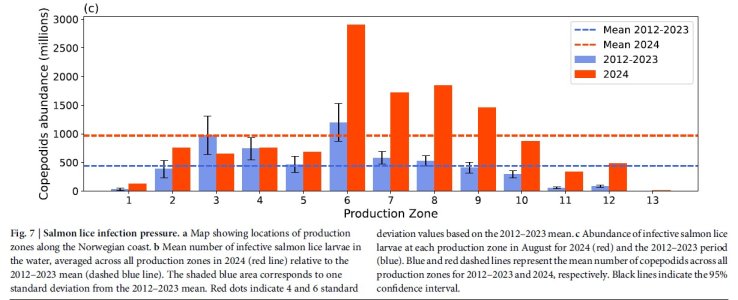
Northern Norway experiences explosive increase in sea lice
The populations of the parasite have never been higher in the region than now, says marine researcher Anne Sandvik
 www.fishfarmingexpert.com
Last edited:
Police raid offices of Norwegian salmon exporter
The company denies that it, or any of its employees, have committed any criminal offenses.
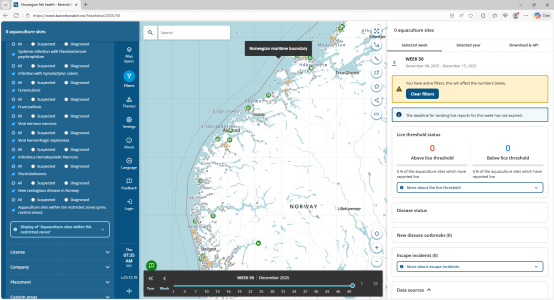
This is how Norway demonstrates transparency & accountability wrt publicly- accessible information on ONPSF disease & parasite outbreaks:
and this is how CFIA does it in Canada:
 inspection.canada.ca
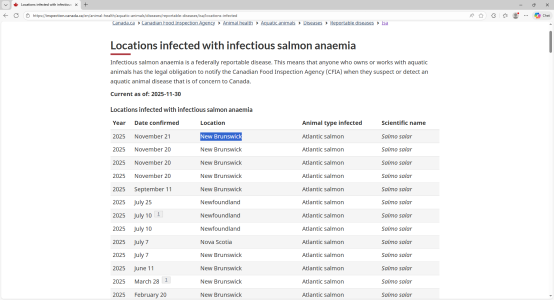
PURPOSELY vague & useless for 3rd parties to go out and test adjacent wild stocks.
and this is how CFIA does it in Canada:
Locations infected with infectious salmon anaemia - inspection.canada.ca
PURPOSELY vague & useless for 3rd parties to go out and test adjacent wild stocks.
Chilean salmon nightmare comes north: Researchers race to contain it in Norway
New North Atlantic project launched to study piscirickettsiosis in farmed salmon. Norway’s Veterinary Institute has launched a new research project on piscirickettsiosis in the North Atlantic, following an increase in disease cases in Scotland and Ireland and outbreaks at several Norwegian sites...
 www.salmonbusiness.com

Removal of BC salmon farms coincides with rebounding wild runs
 www.nationalfisherman.com
What a one-sided slant. What about all the runs and averages up and down the coast,even on the north coast with no farms and some good runs where there are farms. Too many variables to say the removal of a few farms nade a difference. AM must see an in to make more money.... please donate today..... lol
Ya they mention our ol bud Dawson in thereWhat a one-sided slant.

Episode 3 - Burgeo

Episode 3 - Burgeo — SAVING SALMON
As salmon farming is being banned in places like Washington State and British Columbia, governments in Atlantic Canada are welcoming the industry with open arms. After years of broken promises and environmental catastrophes, public opposition in places like Newfoundland and Labrador is growing. Bob
 www.savingsalmon.ca
As salmon farming is being banned in places like Washington State and British Columbia, governments in Atlantic Canada are welcoming the industry with open arms. After years of broken promises and environmental catastrophes, public opposition in places like Newfoundland and Labrador is growing. Bob Keating visits Burgeo, a community on Newfoundland’s south coast to hear from citizens who want a future without sea cages.
Episode 4 - An Interview with Neville Crabbe

Episode 4 - An Interview with Neville Crabbe — SAVING SALMON
Bob speaks with Neville Crabbe, ASF’s Vice President of Communications and Special Projects about the future of salmon farming in Atlantic Canada.
www.savingsalmon.ca
Bob speaks with Neville Crabbe, ASF’s Vice President of Communications and Special Projects about the future of salmon farming in Atlantic Canada.
Similar threads
- Replies
- 0
- Views
- 476

- Replies
- 5
- Views
- 814
- Replies
- 12
- Views
- 2K

- Replies
- 0
- Views
- 276