

Peahead
Well-Known Member
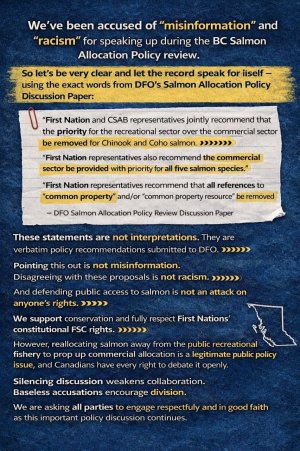
It tells me that SFI and BCWF along with PFA have been doing a great job of getting the word out and standing up for the public and an equal opportunity to the salmon resource once we get past FSC rights which comes first ( and after conservation). I am not surprised there would be push back and I am also not surprised they would pull the "race card" or references to reconciliation. It is interesting that the letter points out that the public rec sector misrepresents what FN wants out of a proposed change to SAP but then they don't provide any detail why it misrepresents it or what they want out of it. No explanation of why they feel a change in taking priority of access of chinook and coho away from the public recreational to provide that access priority to non-FN commercial and FN commercial. Please tell us why the residents of BC and Canada should be supportive of the salmon no longer being a priority resource for them and why it makes sense that priority go to the commercial sector. It just happens to be mostly FN commercial now but this refers to both non-FN and FN commerciall.
Canada is in a time of desperately needing to breath some life back into it's economy. If our government is serious about Sovereignty and making the economy stronger, they would not even consider this proposed change to SAP. Any massive loss to the public's access of chinook and coho will all but destroy BC's public recreational fishery. Certainly the public salmon fishery will be gone as we know it. To provide priority of a public resource (salmon) that bring in an especially massive dollar value to our economy over to another sector that brings a tiny fraction of the value, would do catastrophic damage to the fishing economy in BC and Canada. It looks pretty clear now to be another example of our government using salmon as a currency.
This is from a recent document "Potential financial and employment impact of transferring salmon allocation from the B.C. Sport Fishing Sector to the B.C. Commercial Sector.
Reference #1:
Fisheries and Oceans Canada, Pacific Region, 2023 Economic
Profile of all BC Recreational Fisheries,
secteur/pac-wild-fisheries-peches-sauvage/bc-rec-fisheries-pecheries-rec-cb-
eng.html
Reference #2: Final Report, “The Supply Sector for the Commercial Fishing
Fleet, understanding Linkages between Commercial Fishing Operations,
Support Businesses, and Coastal Communities.” Counterpoint Consulting.
Funded by Fisheries and Oceans Canada.
eng.pdf
Statement:
For every 5,561 fish transferred from the Sport Fishing Sector to the
Commercial fishing sector the Canadian economy will lose $4,644,226
and lose 32.7 jobs.
The majority of the 5,561 fish will be exported from Canada and not
available as high value protein for Canadians.
Conclusion #1:
Salmon sport fishing in B.C. generates the highest cost benefit
value of $847 as compared to the Commercial Sector at $11.84 per salmon;
In British Columbia the sport caught salmon provides the greatest value added benefit
as high protein food and social and sustainable economic jobs to the people of
Canada.
Conclusion #2:
The loss of jobs in the recreational sector will be across all
support sectors. Canadians working in tourism (hotel, motel, cleaning, restaurants,
transportation), supply (boats, fishing equipment, maintenance, moorage), guides,
etc. will lose jobs in communities across British Columbia
Conclusion #3:
DFO should not transfer fish allocation from the Sport Fishery
to the Commercial Fishery. DFO priorities should focus on increasing salmon
abundance by improving habitat, promoting research in selective fishing technologies
and in select cases, increase hatchery production and marking of fish so that all
fishing sectors can prosper.
Canada is in a time of desperately needing to breath some life back into it's economy. If our government is serious about Sovereignty and making the economy stronger, they would not even consider this proposed change to SAP. Any massive loss to the public's access of chinook and coho will all but destroy BC's public recreational fishery. Certainly the public salmon fishery will be gone as we know it. To provide priority of a public resource (salmon) that bring in an especially massive dollar value to our economy over to another sector that brings a tiny fraction of the value, would do catastrophic damage to the fishing economy in BC and Canada. It looks pretty clear now to be another example of our government using salmon as a currency.
This is from a recent document "Potential financial and employment impact of transferring salmon allocation from the B.C. Sport Fishing Sector to the B.C. Commercial Sector.
Reference #1:
Fisheries and Oceans Canada, Pacific Region, 2023 Economic
Profile of all BC Recreational Fisheries,
secteur/pac-wild-fisheries-peches-sauvage/bc-rec-fisheries-pecheries-rec-cb-
eng.html
Reference #2: Final Report, “The Supply Sector for the Commercial Fishing
Fleet, understanding Linkages between Commercial Fishing Operations,
Support Businesses, and Coastal Communities.” Counterpoint Consulting.
Funded by Fisheries and Oceans Canada.
eng.pdf
Statement:
For every 5,561 fish transferred from the Sport Fishing Sector to the
Commercial fishing sector the Canadian economy will lose $4,644,226
and lose 32.7 jobs.
The majority of the 5,561 fish will be exported from Canada and not
available as high value protein for Canadians.
Conclusion #1:
Salmon sport fishing in B.C. generates the highest cost benefit
value of $847 as compared to the Commercial Sector at $11.84 per salmon;
In British Columbia the sport caught salmon provides the greatest value added benefit
as high protein food and social and sustainable economic jobs to the people of
Canada.
Conclusion #2:
The loss of jobs in the recreational sector will be across all
support sectors. Canadians working in tourism (hotel, motel, cleaning, restaurants,
transportation), supply (boats, fishing equipment, maintenance, moorage), guides,
etc. will lose jobs in communities across British Columbia
Conclusion #3:
DFO should not transfer fish allocation from the Sport Fishery
to the Commercial Fishery. DFO priorities should focus on increasing salmon
abundance by improving habitat, promoting research in selective fishing technologies
and in select cases, increase hatchery production and marking of fish so that all
fishing sectors can prosper.