Who caught what in 2025 and the respective economic values/impacts of the catch.
This takes us to who caught what in 2025 and the value of the catch by commercial and recreational fishers.
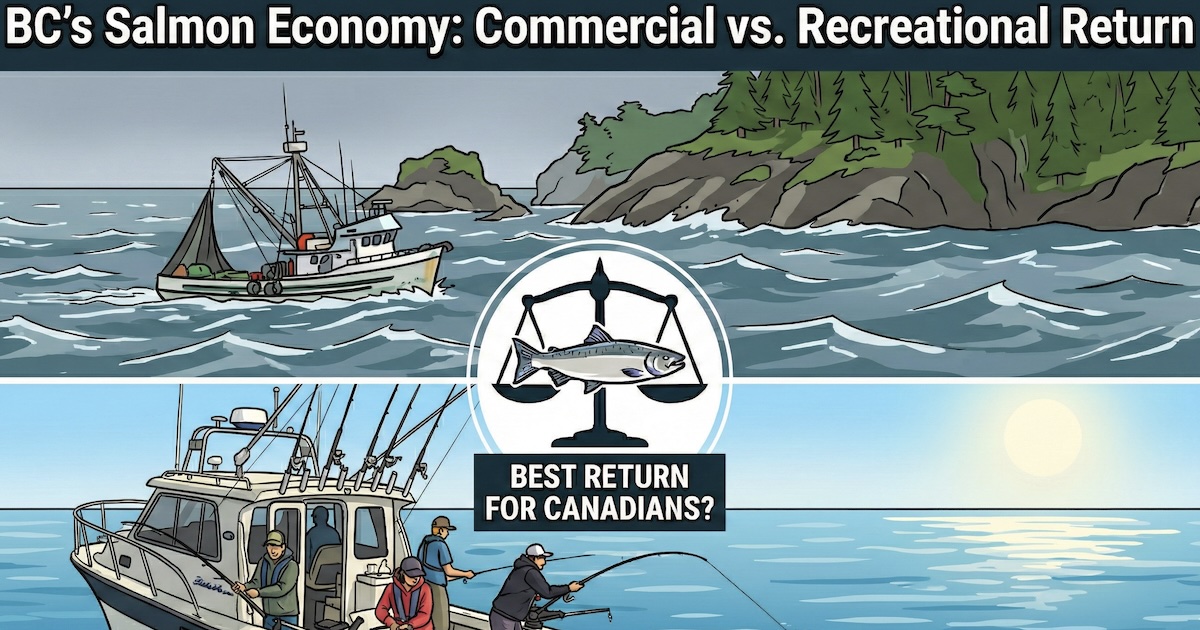
I think most readers would be surprised to learn that the economic value of the recreational fishery was many, many times that of the commercial salmon fishery. When we think about the B.C. salmon fishery, images of commercial fishermen come to mind. But this image belongs to history books and romantic recollections of our coastal economy. Instead of picturing a commercial gillnet or troller fishing an isolated part of the B.C. coast or moored in a coastal community; picture a charter boat filled with clients, a large lodge, or packs of sport boats fishing outside Victoria, Nanaimo, Prince Rupert, or Vancouver.
Many would also be surprised that the largest commercial harvesters of B.C. salmon – measured in both catch and value – were US fishermen, not Canadian.
In considering the table below, it is important to note that I am comparing apples and oranges. I have used wholesale value for commercial landings and total expenditures for the recreational fishery. These are the best data I could find for both (see links below). But using wholesale values for the commercial fleet understates its economic impacts because it leaves out the economic activity between the processor and the eventual consumer. One could easily double or triple my estimates for the commercial fleet. But this doesn’t detract from the fact that the economic impact of the recreational fishery was many times greater than the commercial fishery in 2025. As an additional check, I compared the GDP of the two sectors. It only confirmed the wide disparity.
Preparing this report led me to begin thinking of the value of discards. Over one million salmon were discarded in 2025. A reasonable estimate would be that 30 to 50% of the discards died before spawning. My analysis grants these dead discards zero value. One could argue that the retention fisheries could not have happened without allowing the discards. Hence, they might be considered a subsidy granted by the people of Canada to the respective fisheries. But surely, if we are going to kill 300,000 to 500,000 salmon, we should attach some value to them, even if it is only to recognize what we, as society, are choosing, or maybe just grant them some respect?