

You are using an out of date browser. It may not display this or other websites correctly.
You should upgrade or use an alternative browser.
You should upgrade or use an alternative browser.
Guide licensing
- Thread starter Unreel
- Start date

CalCom
Member
This is differentSage advice I’m sure !
No I’m thinking how it compares to hauling logs and other commercial ventures on pavement
I mean water should be safer than a highway with big steel vehicles within inches sometimes going opposite direction on a closed course roadway
If you take someone on your boat and they pay you anything, be it for fuel, fishing, whatever, that puts you in a (potentially) commercial situation, especially if you can’t prove they are long-time friends/acquaintances). If they sprain their ankle on your boat, that puts you in a liability position… this is important to remember…behind every recreational user/client is a lawyer. And personal liability lawyers get paid based on what they settle for, so you know that will be as much money as they can go for.
It sucks to say, but we now live in a litigious society….I remember the days that if you slipped on ice you cursed yourself for being clumsy. Now, there are legal firms that specialize on crap like this.
Back to the main point…making a few bucks taking someone you may not know sounds like a good plan and easy money, but if you and your insurance company are not on the same page you could be a massive loser. I’m really not trying to fear monger, but coming from a position of knowing insurance companies, I can’t see taking on such risk.
Again, IMHO
CalCom
Member
And I’m in agreement with you the same applies to everything we do in society but judges have a different way of seeing things
Than blood sucking ambulance chasing pests
I guess you don’t know the cost
For logging it varies a lot depending on overall weight but can go up to two to three grand a month depending on fleet status and other variables


beemer
Well-Known Member
If you are “C” registered it is a good idea for you to read the Marine Liability Act and how it applies to you. Most guides don’t realize that their liability is limited if they take certain actions. Pass this on to your insurer.
 tc.canada.ca
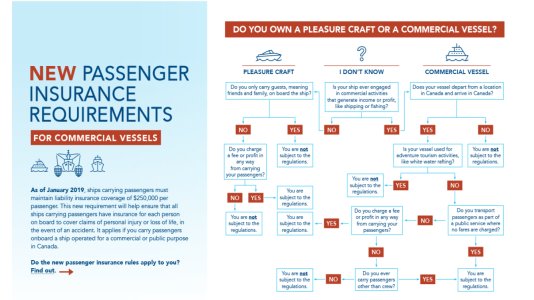
Marine liability and compensation: Passenger vessel insurance
Passenger Insurance Requirements in Canada
Last edited:

Clint r
Well-Known Member
If you are “C” registered it is a good idea for you to read the Marine Liability Act and how it applies to you. Most guides don’t realize that their liability is limited if they take certain actions. Pass this on to your insurer.
Marine liability and compensation: Passenger vessel insurance
Passenger Insurance Requirements in Canada
Here’s an image of their flow chart.

Unreel
Well-Known Member
Yes im aware of the changes to the svop for small commercial vessels. I was refering to something coming from DFO for fishing guide regulations or licensing.Copied this off Datum Marine webpage:
Transport Canada has proposed some changes to the Small Vessel Operator training regime (currently the SVOP certificate). The validity of SVO certifications may be extended to operators of larger vessels (up to 12 meters long). Nothing is finalized yet, but here’s what we know so far:
1. Any changes to the SVOP course will not come into effect until 2024 (or later!)
2. Existing SVOP certificates will still be valid, but holders may have to take additional courses if they want to operate larger vessels (more than 5GT, less than 12m)
3. The SVOP course will probably be a few hours longer
Transport Canada is changing from a Gross Tonnage measurement for boats to a length measurement. This is a much easier measurement, as it just involves measure the length of your boat! The current SVOP is good for vessels up to 5 GT, which is generally about 9 meters long, the new SVOP will be good for vessels up to 12 meters long. We hope these changes will mean a “new and improved” SVOP for bigger boats.
When I took my course, our teacher was the guy who helped transport Canada write the training manual. He told us we’re good up to 40’ and 12 passengers and current SVOP holders will be grandfathered in to whatever the new regs will be.

Captain PartyMarty
Crew Member
250k seems low. I took the max my insurance would give 1.25mil per guest. Just in case I have drs on board

What people don't understand is that you don't even have to have an accident to be sued. Some one could find out you don't have the proper qualifications to take paying customers and then claim they were traumatized by feeling unsafe for 8 hours and is now suffering lasting effects from it. ( ie: not able to get in a boat again) There are just as many people/customers out there looking for opportunities to make easy money as their are unscrupulous fishers looking for ways to cheat. The guys I shake my head at are the ones running paying clients offshore for tuna without the proper insurance or equipment to do it legally. The perfect scenario to scare the crap out of someone coming back into early morning hours on a kicker motor because the main broke down. It will happen.
The proper safety system for those trips is having the proper radios on board that can reach Coast Guard from those distances a life raft on board for everyone in the event of fire or sinking, Eperb to take with you so they know you are in trouble and can find you quickly. A kicker is not required equipment and wouldn't hold up in court as such. Just saying.Could get sued for farting loudly at home by the neighbours
But let’s be real here if your scenario happens the defence is the safety system worked and brought you home and a refund is offered
Guess it’s some kinda big secret what the cost of insurance is
I would think it is just the cost of doing business
Like in the trucking industry no insurance no work !
But what do I know
Seems like there is a “shade of grey” to chartering or is that just a song I heard once

SpringVelocity
Crew Member
Yes im aware of the changes to the svop for small commercial vessels. I was refering to something coming from DFO for fishing guide regulations or licensing.
You know what that is. Guarantee they are going close the loophole for data reporting. That would be my guess. I wonder if it ties into the MSF they are trying to implement.
As it stands the guiding logbook program is supposed to be followed but many don't do it. Wonder if DFO is going fix that.
Last edited:


BC Coast Pilot
Well-Known Member
The marine liability act limits the amount paid out per occurence.250k seems low. I took the max my insurance would give 1.25mil per guest. Just in case I have drs on board
Claims — no contract of carriage
(2) The maximum liability for maritime claims that arise on any distinct occasion for loss of life or personal injury to persons carried on board a ship of less than 300 gross tonnage otherwise than under a contract of passenger carriage is the greater of
- (a) 2 000 000 units of account, and
- (b) 175 000 units of account multiplied by
- (i) the number of passengers that the ship is authorized to carry according to any Canadian maritime document required under the Canada Shipping Act, 2001, or
- (ii) the number of persons on board the ship, if no Canadian maritime document is required under that Act.

coastalmarinesafety
Active Member
Any significant new licensing regime like that for “commercial sport fishing” would involve quite a bit of consultation and wouldn’t be just a rumour. The SFI and those on the regional boards would hear about it and send out notice. If that hasn’t happened, then likely not being proposed at this time.

Rain City
Crew Member
And the notice likely wouldn't include gratuitous exclamation points.Any significant new licensing regime like that for “commercial sport fishing” would involve quite a bit of consultation and wouldn’t be just a rumour. The SFI and those on the regional boards would hear about it and send out notice. If that hasn’t happened, then likely not being proposed at this time.

fishin_magician
Well-Known Member
Not sure I see a need for actual guide licenses…what I see is more of a need for enforcement of rules against fly by night operators who want to seek identity by running a few trips and then calling themselves a guide. They are the ones which don’t have approved floatation on board, lack skills and have poorly maintained mechanicals. There are LOTS of these people on the coast now to be honest-it’s these folks which are going to create a big issue for those running legitimate businesses working their tail off for 25-30% short run gross margin.

bryce
Crew Member
What they need is more enforcement and way way way harsher penalties.Not sure I see a need for actual guide licenses…what I see is more of a need for enforcement of rules against fly by night operators who want to seek identity by running a few trips and then calling themselves a guide. They are the ones which don’t have approved floatation on board, lack skills and have poorly maintained mechanicals. There are LOTS of these people on the coast now to be honest-it’s these folks which are going to create a big issue for those running legitimate businesses working their tail off for 25-30% short run gross margin.

searun
Well-Known Member
Its one of the initiatives being investigated under the PSSI (Pacific Salmon Strategy Initiative), shared with the SFAB by DFO over a year ago.Any significant new licensing regime like that for “commercial sport fishing” would involve quite a bit of consultation and wouldn’t be just a rumour. The SFI and those on the regional boards would hear about it and send out notice. If that hasn’t happened, then likely not being proposed at this time.
Work is underway to investigate options for developing a Guide Licensing framework - so we won't likely hear much more until those investigative efforts narrow down the mechanics necessary to design a few options that could be recommended for refinement (including public consultation). So likely a ways off for now, but as mentioned in SV's post, one of the drivers behind Guide Licensing was making completing Guilde Log Books as a condition of license similar to what the Commercial fleet now has - in this way, the Department can gather more robust catch data necessary to more effectively manage the recreational fishery.
coastalmarinesafety
Active Member
Only took 50 posts to get an up to date answer on the original post. Thanks for this.Its one of the initiatives being investigated under the PSSI (Pacific Salmon Strategy Initiative), shared with the SFAB by DFO over a year ago.
Work is underway to investigate options for developing a Guide Licensing framework - so we won't likely hear much more until those investigative efforts narrow down the mechanics necessary to design a few options that could be recommended for refinement (including public consultation). So likely a ways off for now, but as mentioned in SV's post, one of the drivers behind Guide Licensing was making completing Guilde Log Books as a condition of license similar to what the Commercial fleet now has - in this way, the Department can gather more robust catch data necessary to more effectively manage the recreational fishery.
searun
Well-Known Member
I would be remiss if I also didn't add that one possible outcome of those investigations might be that there isn't a viable mechanism to facilitate designing a guide licensing scheme.
One hurtle that occurs to me is, once DFO implements electronic licensing using platforms such as Fishing BC app, where individual anglers are required to record their catch onto an electronic license platform, then that negates some of the business case to license guides and require as a condition of license completion of a guide log book to capture catch data.
Is the juice worth the squeeze in a modernized license and catch recording environment?
One hurtle that occurs to me is, once DFO implements electronic licensing using platforms such as Fishing BC app, where individual anglers are required to record their catch onto an electronic license platform, then that negates some of the business case to license guides and require as a condition of license completion of a guide log book to capture catch data.
Is the juice worth the squeeze in a modernized license and catch recording environment?

wolf
Well-Known Member
Just like DFO that app is a complete joke we took a picture of a pink and it came up as 99.5 % chinook in the identifier ...FIRST then need to enforce WHAT they dont do ..monitor the non registered and non compliante guides that advertise and no certs etc UNTIL they do that good luck on anything else... we have at least 10 "new" guys with F all here in sooke undercutting and no experience..
Similar threads

- Replies
- 2
- Views
- 2K


- Replies
- 8
- Views
- 1K

- Replies
- 7
- Views
- 905

- Replies
- 7
- Views
- 3K
