

You are using an out of date browser. It may not display this or other websites correctly.
You should upgrade or use an alternative browser.
You should upgrade or use an alternative browser.
Driving an EV pickup
- Thread starter sly_karma
- Start date

zurk
Well-Known Member
$86 for electricity to whistler and back ? oh wow.
290km/180 miles at 20mpg in my gas guzzling SUV or minivan is 9 gallons or 45 bux at 5 bux/gallon or $61 in canadian.
11.76l./100km at 2 canadian per litre is 35.28 x 2 = $70.56 canadian.
math isnt mathing here. my towing minivan cost me $12K to buy and its more economical on fuel than a $80K lightning.
290km/180 miles at 20mpg in my gas guzzling SUV or minivan is 9 gallons or 45 bux at 5 bux/gallon or $61 in canadian.
11.76l./100km at 2 canadian per litre is 35.28 x 2 = $70.56 canadian.
math isnt mathing here. my towing minivan cost me $12K to buy and its more economical on fuel than a $80K lightning.
Whistler to Penticton is about 450 km$86 for electricity to whistler and back ? oh wow.
290km/180 miles at 20mpg in my gas guzzling SUV or minivan is 9 gallons or 45 bux at 5 bux/gallon or $61 in canadian.
11.76l./100km at 2 canadian per litre is 35.28 x 2 = $70.56 canadian.
math isnt mathing here. my towing minivan cost me $12K to buy and its more economical on fuel than a $80K lightning.

zurk
Well-Known Member
ok that makes sense if the distance was 900Km vs vancouver - whistler. so $210 in fuel for my minivan vs $83 for a lightning to go 900km or slightly over double in fuel costs compared to an EV.Whistler to Penticton is about 450 km

sly_karma
Crew Member
For sure. Lightning uses 32-35 kWh/100 km on the highway, Tesla 3 or Y both in the 22-24 range.Keep in mind, that’s a body-on frame pickup EV. Compare to a lighter/more aerodynamic EV and I suspect those charging costs would be even lower.

Bifmalibu
Well-Known Member
You're talking about storing fuel for up to two years. Any volume of fuel that can actually accomplish any amount of work will consume much more space than a battery. And you are comparing emerging battery tech to the best version of internal combustion we have seen and that is backed by a few hundred years of investment and r&d.true. the reason for that is they are so convenient as a medium. coal used to be there as primary energy storage but it was a huge pain to store due to its size and dust would get all over you. then we got whale oil in a bottle and didnt look back. you could pour it around. it moved. it disappeared magically and reduced its weight when it was used. it was a physical object which was easy to store in dedicated tanks which had low weight when empty so easy to transport around.
synthetic fuels should be a good alternative to fossil fuels. make them from cheap coal or CO2 or garbage (biomass). convert to syngas and then to synthetic gasoline or diesel thru hydrocracking.
electricity is not convenient as a storage medium. batteries cant be poured around and even if they dont get dust all over you they still have the same storage problems as coal. its ultimately a solid with substantial weight which is inconvenient to move around or reduce in size for transport. and you cant really reduce its weight to just lug around empties to fill when needed.
zurk
Well-Known Member
true. but we live in the now and i'm not waiting around for a few hundred years of improvements to batteries......
no doubt the battery of 2226 will have antigravity built in to compensate for its weight and able to change form like the terminator on command but its a bit of a while off from reality.
in the mean time - https://en.wikipedia.org/wiki/Energy_density
gasoline is 33.18MJ/L and lithium-ion is ~10MJ/L. even at 35% efficiency for work gasoline consumes less space than a battery.
no doubt the battery of 2226 will have antigravity built in to compensate for its weight and able to change form like the terminator on command but its a bit of a while off from reality.
in the mean time - https://en.wikipedia.org/wiki/Energy_density
gasoline is 33.18MJ/L and lithium-ion is ~10MJ/L. even at 35% efficiency for work gasoline consumes less space than a battery.

kaelc
Crew Member
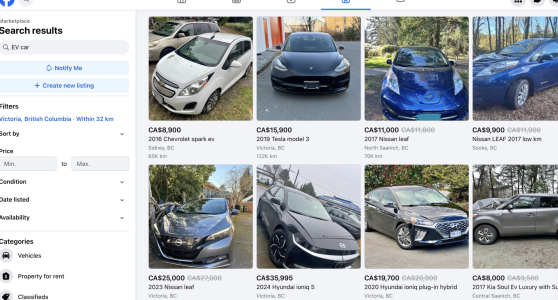
I'm not sure with two oil super powers playing blockade frogger with a big portion of the worlds fuel, it's a great time to advocate for gas over the convenience of batteries, in the province of BC where Hydro power is abundant. What sly is demonstrating is that EV's are easily and cheaply filled up at home, and on the road. Used EV's are getting dam cheap, and are a better comparison to a used Mini-van. Lightning are not cheap but what used pickup truck is cheap? When I look at the cost of a used ford lightning and the cost of backup battery storage at home, the lighning is an attractive option. You get tens of thousands of battery backup and what Sly has outlined as a very nice truck for 50k https://www.facebook.com/share/1CUQC85Z5T/

baddogg
Crew Member
Since the start of this thread, which for some unknown reason I have followed very closely, Sly has given unbiased information for us to read.
I will likely never have an electric vehicle because I average around 4,000 kmh per year and my wife drives her car around 2,000 kmh per year.
I have however told numerous people to look for this thread when they express interest in buying an EV. I appreciate the facts only approach that Sly presents. I'm pretty sure he would make a good EV car salesman.
I will likely never have an electric vehicle because I average around 4,000 kmh per year and my wife drives her car around 2,000 kmh per year.
I have however told numerous people to look for this thread when they express interest in buying an EV. I appreciate the facts only approach that Sly presents. I'm pretty sure he would make a good EV car salesman.

-Jim-
Active Member
I disagree with "in the province of BC where Hydro power is abundant" as that implies there's an excess of Hydro generated power here, but BC has been an importer of electricity for years. Usually that's "dirty" power generated by fossil fuels from the US, and more recently Alberta. The politics of power generation come into play in this equation as nuclear is often dismissed, as they chase solar and wind instead. BC has lots of Natural Gas but the politics is they want to export it for others to use for generation, heat, etc., and don't even let the pipeline use it for their own power generation. Instead they spend mega millions on a powerline to feed the port of export rather than install a small Gas Turbine Generator which would be much cheaper and faster => like everywhere else in the world does. It doesn't make sense to me, but that's politics.
As for Driving an EV Pickup, I think it's a great choice where it fits a person's requirements. One of my son's is looking at an EV Car but as his commute is less than 45 Kms a day, I've been trying to get him to go to a plug in hybrid like a Prius, as he wants a sedan. We need to get off vehicles that add pollutants affecting climate, but the whole equation needs to be considered.
I have friends who say why should we do it when XYZ country isn't (lately fingers are pointing south), but doing the right thing isn't about following the crowd is it?
As for Driving an EV Pickup, I think it's a great choice where it fits a person's requirements. One of my son's is looking at an EV Car but as his commute is less than 45 Kms a day, I've been trying to get him to go to a plug in hybrid like a Prius, as he wants a sedan. We need to get off vehicles that add pollutants affecting climate, but the whole equation needs to be considered.
I have friends who say why should we do it when XYZ country isn't (lately fingers are pointing south), but doing the right thing isn't about following the crowd is it?
kaelc
Crew Member
Agree, I stand corrected and our ability to figure out and offset emissions on the natural gas use way better than using bunker c or whatever the tankers burn for it to be burned with little to no emission standards somewhere else.I disagree with "in the province of BC where Hydro power is abundant" as that implies there's an excess of Hydro generated power here, but BC has been an importer of electricity for years. Usually that's "dirty" power generated by fossil fuels from the US, and more recently Alberta. The politics of power generation come into play in this equation as nuclear is often dismissed, as they chase solar and wind instead. BC has lots of Natural Gas but the politics is they want to export it for others to use for generation, heat, etc., and don't even let the pipeline use it for their own power generation. Instead they spend mega millions on a powerline to feed the port of export rather than install a small Gas Turbine Generator which would be much cheaper and faster => like everywhere else in the world does. It doesn't make sense to me, but that's politics.
As for Driving an EV Pickup, I think it's a great choice where it fits a person's requirements. One of my son's is looking at an EV Car but as his commute is less than 45 Kms a day, I've been trying to get him to go to a plug in hybrid like a Prius, as he wants a sedan. We need to get off vehicles that add pollutants affecting climate, but the whole equation needs to be considered.
I have friends who say why should we do it when XYZ country isn't (lately fingers are pointing south), but doing the right thing isn't about following the crowd is it?
wildmanyeah
Crew Member
Since the start of this thread, which for some unknown reason I have followed very closely, Sly has given unbiased information for us to read.
I will likely never have an electric vehicle because I average around 4,000 kmh per year and my wife drives her car around 2,000 kmh per year.
I have however told numerous people to look for this thread when they express interest in buying an EV. I appreciate the facts only approach that Sly presents. I'm pretty sure he would make a good EV car salesman.
Me and my wife have a diesel golf that gets filled up about 10 times a year or about a every month and a half. Were the same, want to get an EV but the KM's does not make sense.
I am annoyed enough with my batteries from my tools not lasting lol
Last edited:

jackfish
Well-Known Member
Since the start of this thread, which for some unknown reason I have followed very closely, Sly has given unbiased information for us to read.
I will likely never have an electric vehicle because I average around 4,000 kmh per year and my wife drives her car around 2,000 kmh per year.
I have however told numerous people to look for this thread when they express interest in buying an EV. I appreciate the facts only approach that Sly presents. I'm pretty sure he would make a good EV car salesman.
Well, this thread is 64 pages long!
I was curious what would happen if I sent my favorite LLM after the thread for a summary. Here it is:
The 63-page thread on the SportFishing BC forum, titled "Driving an EV pickup," is an extensive real-world log that has evolved from initial skepticism and curiosity (July 2023) into a comprehensive technical resource for BC-based truck owners (April 2026).
The discussion is primarily anchored by user "sly_karma", who documents their ownership of a Ford F-150 Lightning, supported by a community of fishermen, contractors, and boaters.
1. The Financial & Initial Setup (Pages 1–15)
- The Math: The OP purchased an F-150 Lightning XLT Standard Range for ~$70k CAD. They calculated that by replacing their gas truck (spending $600/month on fuel/oil) with an EV ($70/month on electricity), the fuel savings alone covered a massive chunk of the truck’s monthly payment.
- V2H (Vehicle-to-Home): A major early topic was using the truck as a backup battery. Several users (including an electrician) detailed the installation of transfer switches, allowing the truck to power a house for days during BC’s frequent winter power outages.
- The "Frunk" Factor: The front trunk was a massive hit. Users found it perfect for storing expensive fishing gear and groceries securely without needing a truck canopy.
2. The Realities of Towing (Pages 16–35)
As the thread progressed, users began testing the truck with heavy fishing boats (21'–28' Whalers, aluminum CCs).- The "50% Rule": The consensus established that towing a non-aerodynamic boat at highway speeds cuts the range by 45–55%.
- Towing Mechanics: Owners argued the Lightning tows better than gas trucks due to instant torque and a low center of gravity. One user noted it pulled an 8,500 lb wakeboat up a ramp "effortlessly" without tire spin.
- Charging Logistics: A major frustration discussed was the "unhitch tax." Most BC charging stations are pull-in, requiring drivers to unhook their trailers to charge. This remains the biggest deterrent for long-range fishing trips.
3. BC Winter & Mountain Driving (Pages 36–50)
- Steep Grades: The OP highlighted that one-pedal driving is a "game changer" for the Coquihalla and other BC mountain passes. Regenerative braking allows for effortless speed control on steep descents without touching the mechanical brakes, while simultaneously recapturing energy.
- Cold Weather Hits: Winter in the Okanagan/Kootenays saw range drops of 25–30%. Users shared "pre-conditioning" tips—heating the battery while still plugged in at home to mitigate these losses.
4. Comparison & Market Shifts (Pages 51–63)
In the later pages, the discussion expanded to include the wider EV truck market:- Lightning vs. Cybertruck: The group generally viewed the Lightning as the superior "work and fishing" platform because of its traditional bed/hitch layout, while the Cybertruck was seen as more of a "tech toy" with less practical utility for fishermen.
- Tesla Supercharger Access: Discussion turned to Ford’s adoption of the NACS (Tesla) port. Owners celebrated the opening of Tesla Superchargers to Fords, which significantly improved the reliability of long-haul trips through rural BC.
- Long-Term Maintenance: After two years of data, users reported very low maintenance costs—zero oil changes and minimal brake wear—though there was emerging discussion on tire wear, as the heavy weight of the EV can lead to faster tread depletion.
Final Consensus of the Thread
The 63-page journey settles on a practical conclusion:- The Ideal Case: It is the "ultimate daily driver" for anyone who lives in a town, works locally, and tows to local boat launches.
- The Weak Point: It is not yet a perfect replacement for a 3/4-ton Diesel for long-distance, heavy towing (e.g., Vancouver to Prince Rupert) due to the frequency of charging stops and the inconvenience of charging station layouts.
- Community Verdict: Despite the "range anxiety" often discussed, the owners in the thread express a high level of satisfaction, particularly regarding the quiet ride, power, and massive cost savings over time.
jackfish
Well-Known Member
In the spirit of Sly's unbiased data approach:
I have a 2023 Lightning ER with 45,000km. I haven't reset the primary trip counter since the beginning.
Average 28kWh over lifetime.
Usage: Vancouver Island mostly. City, highway, rural. Towing RV (6000 lbs), farm trailers (up to 10,000 lbs), boat (6,000lbs). Summer, winter.
Van Isle winters are mild and most of the highways are 90kph. So that would help keep the kWh down.
I have a 2023 Lightning ER with 45,000km. I haven't reset the primary trip counter since the beginning.
Average 28kWh over lifetime.
Usage: Vancouver Island mostly. City, highway, rural. Towing RV (6000 lbs), farm trailers (up to 10,000 lbs), boat (6,000lbs). Summer, winter.
Van Isle winters are mild and most of the highways are 90kph. So that would help keep the kWh down.
sly_karma
Crew Member
Something else i just noticed when going over charging receipt emails. I have the Tesla app, and use it only to look at locations, peak times and pricing (I don't travel out of town often enough to get value from their $10/month membership). Tesla app shows the supercharger locations in Merritt and Cache Ck both costing $0.35/kWh.
At the charger, I don't use any app, I just plug in and walk away. Ford's Blue Oval network takes care of connection, bills my credit card and emails me a receipt. I just did the math on the four sessions last week, and they all come out at... $0.35/km; ie, Ford doesn't apply a convenience fee for handling connection and billing. Amazing!
This is pretty sharp pricing BTW. BC Hydro just raised their pricing to $0.3941/kWh, and only a handful of their installations achieve speeds in the same league as Tesla. Chevron (Journie) varies from $0.40-0.45, and a bunch of their units are offline completely while they replace the old internal battery chargers with fully powered units. Electrify Canada is a ridiculous $0.70/kWh. Petro Canada (if you can find one in running condition) is $0.50/kWh. Tesla prices do vary from location to location, and some site have surge pricing, ie, more expensive at peak times, but overall they offer reliably high speeds, lots of plugs and sharp pricing. I hold my nose a bit because of the CEO's **** antics, but there's a limit. My pushback is not to buy his cars or internet service.
At the charger, I don't use any app, I just plug in and walk away. Ford's Blue Oval network takes care of connection, bills my credit card and emails me a receipt. I just did the math on the four sessions last week, and they all come out at... $0.35/km; ie, Ford doesn't apply a convenience fee for handling connection and billing. Amazing!
This is pretty sharp pricing BTW. BC Hydro just raised their pricing to $0.3941/kWh, and only a handful of their installations achieve speeds in the same league as Tesla. Chevron (Journie) varies from $0.40-0.45, and a bunch of their units are offline completely while they replace the old internal battery chargers with fully powered units. Electrify Canada is a ridiculous $0.70/kWh. Petro Canada (if you can find one in running condition) is $0.50/kWh. Tesla prices do vary from location to location, and some site have surge pricing, ie, more expensive at peak times, but overall they offer reliably high speeds, lots of plugs and sharp pricing. I hold my nose a bit because of the CEO's **** antics, but there's a limit. My pushback is not to buy his cars or internet service.
sly_karma
Crew Member
Wow that's low for sure. My lifetime econ is 33 kWh/100 km. You've identified the key reasons why.In the spirit of Sly's unbiased data approach:
I have a 2023 Lightning ER with 45,000km. I haven't reset the primary trip counter since the beginning.
Average 28kWh over lifetime.
Usage: Vancouver Island mostly. City, highway, rural. Towing RV (6000 lbs), farm trailers (up to 10,000 lbs), boat (6,000lbs). Summer, winter.
Van Isle winters are mild and most of the highways are 90kph. So that would help keep the kWh down.
Similar threads
- Replies
- 6
- Views
- 5K

- Replies
- 21
- Views
- 4K


- Replies
- 5
- Views
- 5K
