

You are using an out of date browser. It may not display this or other websites correctly.
You should upgrade or use an alternative browser.
You should upgrade or use an alternative browser.
Confessions of a sportfishing wannabe
- Thread starter smp747
- Start date


BC Coast Pilot
Well-Known Member
Thinking a few moves ahead is key, sounds like you're already doing that. Fenders, ropes ready etc.I appreciate all the great feedback. I used to backcountry snowmobile and I was always the guy that was the most prepared. Gear, avalanche training, tools, extra clothes etc. I guess its the fact that now I'm older with my family on board that makes me more concerned.
I'm not nervous, everyone starts somewhere. I get that.. I just want to be the most prepared I can be and if I have any failures- I want to "fail safe"
Its not so much the docking part, although I'm sure ill hang my head low starting out, but learning to understand and respect the open water- wind, weather, tides etc.
I'll definitely leverage those I know and the resources provided to set myself up. Thank you all for your advice!
Remember to move helm first, then apply propulsion for best effect, bump in and out of gear with correct helm see how she responds. Go slow.....low stress. Enjoy.

BC Coast Pilot
Well-Known Member
Unless you don't know, then ask and work it out together. Referred to on a vessel as Bridge Resource Management or BRM.Always show your crew you’re confident. Nothing worse than a nervous captain. There’s always a way out. Know it.
Your crew is your most valuable resource.
Last edited:
Fetch (distance across water that the wind can blow) and wind direction (related) are really the main determinants of wave height, and safety and comfort in little boats. Sometimes at high tide - one can sneak inside shoals or islands and stay out of the worst of it. Another option is to NOT take it square in the bow, but alternatively zig and zag on safe and comfortable courses - avoiding the worst effects into the swell. Slightly lifting the outboard also raises the bow, but can make it harder to see ahead of you for logs. Again, zigging and zagging helps there too. Most have enuff common sense to slow down as everyone has control of speed (revs), but also tiller (direction) and trimming of their boat (bow). Some forget those last 2 when they panic.I would respectfully suggest that 25 knots is already stay home weather never mind 35 knots or more. Making the run from the south end of Texada to Nanaimo last summer in 22 knot North-West winds in my 24 foot boat was pretty damned uncomfortable. Did I survive? Of course, but there was no room for error or even a moment of lapsed concentration.
For me boating is supposed to be fun so pushing the limits of my boat and/or myself simply doesn’t qualify.
and on the tie-up let go - mooring posts - lines are your best friends - esp. when alone. Could be a whole other thread on this alone. How to tie-up and let-go in wind and how to tie-up for long-term safety and piece of mind.
Last edited:
If one has the opportunity to say no - one can pick and choose to boat on only the enjoyable days. But for many the sea is the normal highway irrespective of those who instead see it as leisure. On the North Coast - SE 35kts is the only break in the weather often for weeks in October/November when 45 gusting 65 is the norm for many days in a row. Many in remote communities do not have the luxury of waiting weeks for enjoyable weather and their realities are very different wrt boats and weather. The term "enjoyable" is also subjective.
For me it is instead about safety. Sometimes it is admittedly not safe enuff. Other times it is merely uncomfortable for a small period of time/area throughout he longer journey. The older one gets tho - the tougher that rough seas/waves gets on the knees and back.
And one should use all of ones skill sets on the water - including reducing risk and improving comfort and safety - always.
For me it is instead about safety. Sometimes it is admittedly not safe enuff. Other times it is merely uncomfortable for a small period of time/area throughout he longer journey. The older one gets tho - the tougher that rough seas/waves gets on the knees and back.
And one should use all of ones skill sets on the water - including reducing risk and improving comfort and safety - always.
Last edited:

Squire
Well-Known Member
If one has the opportunity to say no - one can pick and choose to boat on only the enjoyable days. But for many the sea is the normal highway irrespective of those who instead see it as leisure. On the North Coast - SE 35kts is the only break in the weather often for weeks in October/November when 45 gusting 65 is the norm for many days in a row. Many in remote communities do not have the luxury of waiting weeks for enjoyable weather and their realities are very different wrt boats and weather. The term "enjoyable" is also subjective.
For me it is instead about safety. Sometimes it is admittedly not safe enuff. Other times it is merely uncomfortable for a small period of time/area throughout he longer journey. The older one gets tho - the tougher that rough seas/waves gets on the knees and back.
And one should use all of ones skill sets on the water - including reducing risk and improving comfort and safety - always.
I get your point that having a choice when you can get out is a luxury some don’t have. Before I retired just two years ago the wind seemed to always pick up on the weekends and die down during the work days. A client told me tongue in cheek that I’d get bored when I retired because I couldn’t go fishing every day. I replied that was true but I would then be able to go fishing any day.
I grew up boating and consider myself competent enough to come out the other side of some rough stretches of water. I don’t know if it’s wisdom or just fatigue but I would rather enjoy than endure my time on the water now.
Agreed on all points, Squire. I think there is a big difference between knowingly starting a trip knowing there will be adverse conditions for a period of that trip and taking any and all precautions to mitigate those risks and increase comfort verses blindly getting oneself into a dangerous condition because an inexperienced boat operator didn't realize those risks and plan for them and maybe even panicking and not making safe choices when encountering those conditions.
I think smp747 who started this thread is firmly in the 1st category looking for additional info and support and knowledge transfer - which is the responsible approach and I commend him for that.
I think smp747 who started this thread is firmly in the 1st category looking for additional info and support and knowledge transfer - which is the responsible approach and I commend him for that.

Wondermur
Crew Member
I did a course when i started boating and have learned quite a bit in 15 years. No expert tho and now that I have read all this advice I feel quite nervous to go out on the water!  Good advice tho, just so much of it.
If you have an experienced friend that you trust for the first outing that would be good.
Good advice tho, just so much of it. If you have an experienced friend that you trust for the first outing that would be good.

Capt. Jack
Active Member
Thats OK, I've got a 1982 harbercraft classic 12 with 6 hp zuki.Great thread, keep the advice coming. I am in same boat (pun intended) as OP, except I am out of Nanaimo and working with an even smaller vessel - 14' aluminum with 25hp tiller steer. For now, anyway.
Had it for a year and a half. My poor old back can't handle lifting
12 ft John boat on and off the jeep anymore. Winching a boat on a trailer
Seems alot easier.
I'm doing the same thing, taking little steps, what kind of wind does she like and more importantly not like, what's her top speed? What kind of fuel milage will she get? Just me and with my fishing partner. All these things I want to know before I go to west van area for the pinkies.

Sharphooks
Well-Known Member
Just when you think you’ve got boating figured out.....
Despite having 40+ years of boating under my belt I still managed to get a 30 foot boat stuck on the beach yesterday.
How? I anchored in 20 feet of water which is my normal anchoring depth but I threw out too much scope ( I was leaving the boat unattended so for some reason I thought a lot of scope was a good idea.....NOT! )
I used 3:1 scope just to be safe (50 feet of chain + 10 feet nylon line) —-I should have used 2:1 scope because if I had surveyed my surroundings and taken into consideration the dropping tide (it was heading into a minus 3 at low slack) I definitely would have been cured of using 3:1 scope.
I came back 5 hours later and she was high and dry on the beach.....the 3:1 scope had basically turned into 7:1 scope with the dropping tide and the boat drifted into the shallows and stuck . With thanks to the bearded Dude up above in the sky I had the good sense to raise up the twin Suzuki outboards before leaving the boat ——if I hadn’t ....well.... I don’t want to go there if they’d been in lowered position
I knew I’d have to wait out the tide change so I used that opportunity to scrape barnacles off my transducers and miscellaneous vegetable growth off the outboard bracket...
I then got creative: I inflated my raft, rowed over to the anchor, hauled it into the raft then rowed out to deeper water and dropped it. With a bit of tide change I then used the electric winch to haul me off the beach
Lesson learned on scope: there’s such a thing as using too much for the prevailing conditions
Despite having 40+ years of boating under my belt I still managed to get a 30 foot boat stuck on the beach yesterday.
How? I anchored in 20 feet of water which is my normal anchoring depth but I threw out too much scope ( I was leaving the boat unattended so for some reason I thought a lot of scope was a good idea.....NOT! )
I used 3:1 scope just to be safe (50 feet of chain + 10 feet nylon line) —-I should have used 2:1 scope because if I had surveyed my surroundings and taken into consideration the dropping tide (it was heading into a minus 3 at low slack) I definitely would have been cured of using 3:1 scope.
I came back 5 hours later and she was high and dry on the beach.....the 3:1 scope had basically turned into 7:1 scope with the dropping tide and the boat drifted into the shallows and stuck . With thanks to the bearded Dude up above in the sky I had the good sense to raise up the twin Suzuki outboards before leaving the boat ——if I hadn’t ....well.... I don’t want to go there if they’d been in lowered position
I knew I’d have to wait out the tide change so I used that opportunity to scrape barnacles off my transducers and miscellaneous vegetable growth off the outboard bracket...
I then got creative: I inflated my raft, rowed over to the anchor, hauled it into the raft then rowed out to deeper water and dropped it. With a bit of tide change I then used the electric winch to haul me off the beach
Lesson learned on scope: there’s such a thing as using too much for the prevailing conditions
Helluva story though! I take it no meaningful damage to speak of?Just when you think you’ve got boating figured out.....
Despite having 40+ years of boating under my belt I still managed to get a 30 foot boat stuck on the beach yesterday.
How? I anchored in 20 feet of water which is my normal anchoring depth but I threw out too much scope ( I was leaving the boat unattended so for some reason I thought a lot of scope was a good idea.....NOT! )
I used 3:1 scope just to be safe (50 feet of chain + 10 feet nylon line) —-I should have used 2:1 scope because if I had surveyed my surroundings and taken into consideration the dropping tide (it was heading into a minus 3 at low slack) I definitely would have been cured of using 3:1 scope.
I came back 5 hours later and she was high and dry on the beach.....the 3:1 scope had basically turned into 7:1 scope with the dropping tide and the boat drifted into the shallows and stuck . With thanks to the bearded Dude up above in the sky I had the good sense to raise up the twin Suzuki outboards before leaving the boat ——if I hadn’t ....well.... I don’t want to go there if they’d been in lowered position
I knew I’d have to wait out the tide change so I used that opportunity to scrape barnacles off my transducers and miscellaneous vegetable growth off the outboard bracket...
I then got creative: I inflated my raft, rowed over to the anchor, hauled it into the raft then rowed out to deeper water and dropped it. With a bit of tide change I then used the electric winch to haul me off the beach
Lesson learned on scope: there’s such a thing as using too much for the prevailing conditions
Sharphooks
Well-Known Member
Helluva story though! I take it no meaningful damage to speak of?
The trims tabs on the boat that went onto the “hard” the other day have an auto function that powers the tabs into “up” position when powering off the ignition ....I dislike the sound of that safety option and have read of some guys who disable it on their boats but I sure was glad that both tabs were in “up” position
While scraping barnacles off my transducers a cargo ship went by and the boat was hit broadside by a train of four foot waves which keeled the boat over almost to the gunnels——if the tabs had been in “down” position that incident probably would have broken them off the hull
Short story— three transom mounted transducers and the pair of trim tabs lived to fight another day ...... and I got a lesson in not being quite so cavalier about the amount of scope to throw into my rode when leaving a boat unattended on a falling tide
I have so many stories of my personal screw-ups with boats - it's hard to pick out the most appropriate learning curve to share. And as GH and LH already mentioned: "Good judgment comes from experience. Experience comes from bad judgment or lack of judgment."
Luckily, like smp747 I was able to think ahead and provide alternatives - and not panic when the sh*t happens.
On the getting ashore on a beach and anchoring topic - 2 related and applicable stories:
In many areas on this coast - there is deep water and narrow basins/anchorages. SH just related some of the problems inherent in this situation. The other issue is that many other boaters know this and as darkness happens - many boats can head to the same anchorage. Sometimes there is not enuff room - and only subprime and vulnerable open spots are left - if any. At one time before lawyers got involved - the Coast Guard used to put out mooring buoys to overcome this situation. Most of those buoys are now gone due to maintenance coast and liability issues. So what else can one do?
Carry a long line that can double as either a tow line or a "shore line". A shore line is used instead of and/or in addition to an anchor where the skipper knows of a deeper anchorage that a line can be strung up between 2 large trees on a shore - one tree on a point so that the "anchorage" is in the armpit of the point. This works well if one gets to the anchorage before dark and you have a small skiff to get ashore. Works well if you are using a cove for a home base for a few days. In sailboats - sometimes that happens when a storm brings winds from the wrong direction.
Well I was using one of these shorelines for an extended time and took the skiff to check out a creek. Once I was at the creek I just tied the skiff off to a tree with a long bow line and kicked it out into the deep part because I was only going to be "5 minutes" and the tide hadn't yet started to drop. Those with experience will likely already guess how this goes.
SPOILER ALERT: If you ever say in your head: "I'll only be 5 minutes" or any other small timeframe - kick yourself in the you know what and stop lying to yourself. It only gets you in trouble. As it did for me. I ended-up being like 45 minutes....
Got back to the skiff and the tide had dropped and the skiff found a 5 foot tall boulder and was sitting up on top of it. I knew that if I pushed the heavy aluminium skiff off of the boulder the bottom end would have been toast and maybe even take out the transom. Stranded. So know what to do?
Luckily I did think ahead and I had stashed a small inflatable in the bushes near where one end of the shore line was and left a tire over the side to make boarding easy. So I tromped thru the bush to the inflatable - along the line by hand to the side and in the boat. I waited until high tide @ 2am - get up and do the reverse and get back to the skiff - everyone safe and I only lost some sleep.
Lesson for me: Always think ahead and prep for what can go wrong - don't panic - and always leave a tire over the side when stopped. AND kick myself in the *** whenever I say "I will only be X min".
Another one wasn't my screw-up but instead by someone (a newbie) I knew. Got a call from CG - since they were out of VHF range - they had gone into a nice sand beach (with surf running) sightseeing and dropped the hook but got taken up onto the beach sideways and the tide dropped and left them high and dry. They would have been stuck there for some days until they payed $ for a tug - even if the boat survived. The problem with that is that the next high tide would be at night and would take them even higher up the beach. I ended up showing up at the rising tide just before dark on a rising tide and managed to tow them off the beach using along tow line I had.
The Lessons: sand is there often because the mud is washed out. How does that happen? - surf. Surf fluffs up the sand and washes out mud and is common in more outside facing beaches. Does an anchor hold in sand - nope! So dropping an anchor in front of a sand beach does nothing. And when your leg is up - you have no backup power and get taken onto the beach whether you want it or not. Once they got in front of the beach and pointed to the beach - they got taken into it. I am assuming that was terrifying for them. Most sand beaches are also shallow for a long ways out.
So how so how does one avoid getting taken onto a nice, sand beach? 2 Alternatives:
1/ Don't go there unless you are towing a skiff that you can instead use and anchored the bigger boat in another adjacent spot. And/or find the sheltered rockier, steeper beach that is adjacent to the sand beach and walk to the sand beach from that landing.
2/ Have a really long anchor line some hundreds of feet long and find the mud deeper in front of the sand beach and anchor there and use the skiff.
ALWAYS test the holding ability of your anchor ahead of any assumptions about how well that may work. Drop it and try to drag it. Pick it up and move to another anchorage if it doesn't hold.
Anyways there some lessons for the newbies Hope it helps
Luckily, like smp747 I was able to think ahead and provide alternatives - and not panic when the sh*t happens.
On the getting ashore on a beach and anchoring topic - 2 related and applicable stories:
In many areas on this coast - there is deep water and narrow basins/anchorages. SH just related some of the problems inherent in this situation. The other issue is that many other boaters know this and as darkness happens - many boats can head to the same anchorage. Sometimes there is not enuff room - and only subprime and vulnerable open spots are left - if any. At one time before lawyers got involved - the Coast Guard used to put out mooring buoys to overcome this situation. Most of those buoys are now gone due to maintenance coast and liability issues. So what else can one do?
Carry a long line that can double as either a tow line or a "shore line". A shore line is used instead of and/or in addition to an anchor where the skipper knows of a deeper anchorage that a line can be strung up between 2 large trees on a shore - one tree on a point so that the "anchorage" is in the armpit of the point. This works well if one gets to the anchorage before dark and you have a small skiff to get ashore. Works well if you are using a cove for a home base for a few days. In sailboats - sometimes that happens when a storm brings winds from the wrong direction.
Well I was using one of these shorelines for an extended time and took the skiff to check out a creek. Once I was at the creek I just tied the skiff off to a tree with a long bow line and kicked it out into the deep part because I was only going to be "5 minutes" and the tide hadn't yet started to drop. Those with experience will likely already guess how this goes.
SPOILER ALERT: If you ever say in your head: "I'll only be 5 minutes" or any other small timeframe - kick yourself in the you know what and stop lying to yourself. It only gets you in trouble. As it did for me. I ended-up being like 45 minutes....
Got back to the skiff and the tide had dropped and the skiff found a 5 foot tall boulder and was sitting up on top of it. I knew that if I pushed the heavy aluminium skiff off of the boulder the bottom end would have been toast and maybe even take out the transom. Stranded. So know what to do?
Luckily I did think ahead and I had stashed a small inflatable in the bushes near where one end of the shore line was and left a tire over the side to make boarding easy. So I tromped thru the bush to the inflatable - along the line by hand to the side and in the boat. I waited until high tide @ 2am - get up and do the reverse and get back to the skiff - everyone safe and I only lost some sleep.
Lesson for me: Always think ahead and prep for what can go wrong - don't panic - and always leave a tire over the side when stopped. AND kick myself in the *** whenever I say "I will only be X min".
Another one wasn't my screw-up but instead by someone (a newbie) I knew. Got a call from CG - since they were out of VHF range - they had gone into a nice sand beach (with surf running) sightseeing and dropped the hook but got taken up onto the beach sideways and the tide dropped and left them high and dry. They would have been stuck there for some days until they payed $ for a tug - even if the boat survived. The problem with that is that the next high tide would be at night and would take them even higher up the beach. I ended up showing up at the rising tide just before dark on a rising tide and managed to tow them off the beach using along tow line I had.
The Lessons: sand is there often because the mud is washed out. How does that happen? - surf. Surf fluffs up the sand and washes out mud and is common in more outside facing beaches. Does an anchor hold in sand - nope! So dropping an anchor in front of a sand beach does nothing. And when your leg is up - you have no backup power and get taken onto the beach whether you want it or not. Once they got in front of the beach and pointed to the beach - they got taken into it. I am assuming that was terrifying for them. Most sand beaches are also shallow for a long ways out.
So how so how does one avoid getting taken onto a nice, sand beach? 2 Alternatives:
1/ Don't go there unless you are towing a skiff that you can instead use and anchored the bigger boat in another adjacent spot. And/or find the sheltered rockier, steeper beach that is adjacent to the sand beach and walk to the sand beach from that landing.
2/ Have a really long anchor line some hundreds of feet long and find the mud deeper in front of the sand beach and anchor there and use the skiff.
ALWAYS test the holding ability of your anchor ahead of any assumptions about how well that may work. Drop it and try to drag it. Pick it up and move to another anchorage if it doesn't hold.
Anyways there some lessons for the newbies
Hope it helps
Last edited:
You had the answer with your first alternative. Stay off the silly sand beach and use your boat for what it was meant to do. I have been on plenty of sand beaches, they are all pretty much the same.So how so how does one avoid getting taken onto a nice, sand beach?
1/ Don't go there
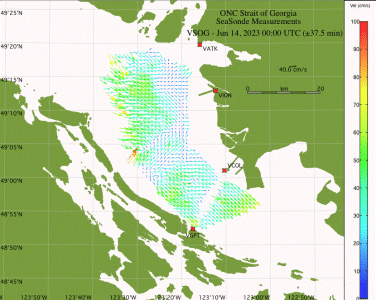
Here's another but new great resource that not everyone in the Salish Sea (SoG) prob knows about:the biggest piece of advice i can give is learn to read wind and tide guides. in my experience nothing can get you in trouble faster than disrespecting wind and tides; or what a tide change can do in different winds.
For example: you may be out there in a slight breeze and everyrhing seems fine. the wind has remained constant, but underneath your boat the tide has changed and is now going in the opposite direction. all of a sudden it’s rough as hell and you have miles of crappy water to pound thru to get home.
that’s my two cents
Last edited:
Similar threads


- Replies
- 6
- Views
- 651


- Replies
- 18
- Views
- 516
- Replies
- 3
- Views
- 674
