Trudeau promises more gun control and goes on the attack against Scheer

Statement by Minister Anandasangaree on strengthening firearms regime​

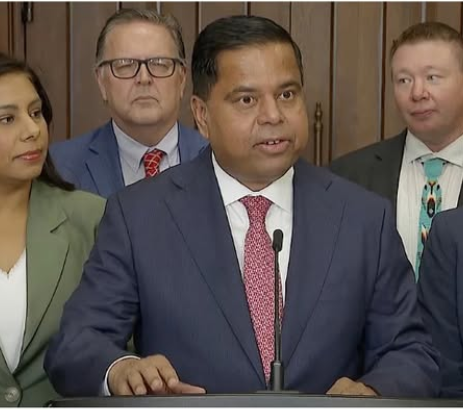
December 4, 2025 – Ottawa, ON - Today, the Honourable Gary Anandasangaree, Minister of Public Safety, issued the following statement:

“Canadians deserve to live in communities that are safe, secure, and free of firearms violence. From removing assault-style firearms from our streets to reinforcing border security, our government continues to take decisive action. I am pleased to announce that the Government of Canada is taking three more important steps to better control firearms and protect Canadians."

Protection Order Regulations

To protect people in at-risk situations, including situations involving gender-based or intimate partner violence, the Government of Canada is moving forward with Protection Order regulations, as called for under former Bill C-21.

This week, regulations were tabled in Parliament that would support the full implementation of the mandatory licence refusal and revocation requirements brought into force in Spring 2025. Engagement is ongoing. Work is actively underway to address feedback from victims, such as the inclusion of peace bonds, and to bring the regulations forward in Spring 2026.

Stronger Classification Requirements

We are also strengthening the firearms classification regime to make sure all makes and models of firearms are accounted for prior to entering the Canadian market.

Regulatory amendments have been tabled in Parliament that would require all domestic manufacturers and importers to share technical information with the Registrar of Firearms for classification before manufacturing or importing any batch or shipment of firearms.

Complementing this measure, we intend to follow through on our platform commitment to bring forward additional legislative measures to further strengthen this regime. This would ensure the correct classification of firearms by competent government authorities before they reach the Canadian market.

Modernizing the Classification Regime

Taking into consideration the Mass Casualty Commission’s report; advice from the Expert Advisory Panel on Firearms and industry representatives; and calls from firearms owners and firearms control advocates, the Government of Canada will shortly be launching a comprehensive review of the firearms classification regime with an emphasis on simplicity and consistency. This review will be supported by an expanded advisory group, and will involve dedicated consultations with First Nations, Inuit and Métis communities, including on the SKS, to ensure Indigenous perspectives and traditions are an active part of the process. The review will take a broad view of the legal framework for firearms, devices, magazines and ammunition to modernize the regime and ensure Canadians’ safety.

We will ensure that the views of Canadians are considered throughout this review. Perspectives of firearms experts, Indigenous peoples, industry, firearms owners and hunters will be integral to its success.”


The highlighted portions are truly out to lunch IMO.
There are no "competent government authorities" in these matters. Period.
The suggestion that the views of Canadians are being "considered" is FAR from reality!
They have shoved this up our butts from the word Go and they know it.
Lying appears to be the very nature of anyone in government associated with this file.

Reality...
 
In their usual response to the anniversary of the 1989 Ecole Polytechnique massacre (36 years ago) the Feds came out with a new list of guns being added to the Prohibited list:


Alberta's gun-grab resistance is part of a bigger Canadian tradition​

This isn't the first time a province has said 'no' to a poorly thought out federal attack on gun owners

This isn't the first time a province has said 'no' to a poorly thought out federal attack on gun owners

Once upon a time, there was a provincial justice minister who abhorred a new, far-more-expensive-than-originally-quoted federal gun program that infringed upon the lives of private citizens. So, he decided not to enforce any of it.

I’m not referring to Alberta Justice Minister Mickey Amery and his move against federal gun seizures on Wednesday, which signalled to all provincial entities that they should not participate in the buyback program. This is about a group of justice ministers in the early 2000s who refused to play ball when it came to the federal long-gun registry.

It turns out that provincial resistance against federal firearm crackdowns is somewhat of a tradition in Canada, and it provides some optimistic foreshadowing for Alberta.

The long-gun registry was created in the 1990s. Branded as a simple safety measure, it imposed new regulatory requirements on the owners of uncontroversial shotguns and rifles without improving public safety, and was fought in the courts by opposing provinces.

By 2003, it had already ballooned in cost from $2 million to $1 billion. Nevertheless, by that time, it had the backing of the Supreme Court of Canada, which had ruled that gun control was a federal matter. To that, several provinces said, “So what?”

The justice ministers of British Columbia, Alberta, Saskatchewan, Manitoba, New Brunswick and Nova Scotia told their police and prosecutors not to enforce the program. There were still federal prosecutors and the RCMP who weren’t under provincial control, but it sent a strong message regardless.

The three Prairie provinces announced their non-enforcement directives in 2000 (and Alberta would go on to fight the registry in other ways). By 2003, the list of provinces pushing back against the registry had grown to include Nova Scotia and New Brunswick. B.C. and Ontario also voiced their opposition.

Complaints from premiers and their justice ministers cited the registry’s uselessness and wastefulness — and expressed annoyance that it was brought to life in the first place. “It’s their law, let them enforce it,” then-Nova Scotia justice minister Jamie Muir said in 2003, referring to the federal government.

“We don’t want to perpetuate this waste of taxpayers’ dollars,” said then-New Brunswick premier Bernard Lord. The federal government should end gun registration, he added.

These non-enforcement orders were not solid protection against all prosecutions — the feds could still advance charges if they so wished, and provincial prosecutors could ignore the direction from on high.

A 2006 judgment ordering the destruction of an unregistered gun in Saskatchewan, which its owner didn’t register due to his personal opposition to the registry, is evidence that at least some cases still made it to court.

Still, brazen provincial opposition sent a message to the federal government and sullied the public reputation of the registry. It also showed Canadians that Ottawa’s will didn’t have to stand unchallenged.

In the end, the registry was largely a failure. While many registered their guns, a good many others didn’t. And by 2006, Stephen Harper was prime minister and used his power to order non-enforcement at the federal level.

The program was finally abolished in 2012. And today, its essence seems to have been reincarnated as the Liberals’ plan to outlaw previously legal firearms and then acquire them from their owners.

The federal push in recent years to ban the invented category of “assault-style firearms” was not based on crime statistics, which shows that gun crimes are overwhelmingly committed with illegal firearms.

The program has also exploded in cost: initially pegged at $600 million or less, it’s now projected to cost somewhere around $1.8 billion. And once again, many gun owners are refusing to participate, holding out hope that the program will eventually be scrapped (good luck with that).

This time around, the provinces are being more co-operative. Alberta and Saskatchewan are once again trying to stick it to the feds, but Nova Scotia submitted and was the place where the program was piloted. New Brunswick seems open to helping out the federal Liberals as long as it doesn’t tie up policing resources.

In Alberta, the justice minister has made a motion under the provincial Sovereignty Act to instruct provincial entities — municipalities, police agencies, the prosecution service, etc. — not to participate in the buyback.

This could have been a simple ministerial direction, but instead the province has opted to use the more complicated machinery of the Sovereignty Act to get its message across. Yet the result is the same: much like in the early 2000s, the province isn’t going to participate.

But these refusals still leave Alberta gun owners vulnerable, which is why the province should also take a similar path as Saskatchewan and make any entity that seizes a gun liable for compensating its owner at market rates. For added spice, it could make individuals personally liable, too.

Guns fall under federal jurisdiction, so the only way to truly end the seizure is by electing a different federal government. But the next best response is to lay down as many impediments to enforcement as possible at the provincial level. You can’t halt the program, but you can refuse help — and better yet, you can introduce risk to dissuade anyone else from helping, too.


Poll: Should the federal government expand its list of banned rifles?​

The federal government will move ahead with a promised review of Canada's firearms classification regime that will include consultations with Indigenous communities on the SKS rifle, Public Safety Minister Gary Anandasangaree said.

The classification review, first announced in March, will take a broad view of the legal framework for firearms, ammunition and magazines while emphasizing simplicity and consistency, Anandasangaree said in a media release.

The government has been heavily criticized by gun control advocates for not including the semi-automatic SKS in its list of banned firearms.

Since May 2020, Ottawa has outlawed approximately 2,500 types of guns on the basis they belong on the battlefield, not in the hands of hunters or sport shooters.

The government says a federal buyback program will provide owners fair compensation for their outlawed firearms.

Ottawa has budgeted more than $700 million for the buyback effort.

Firearm rights advocates and the federal Conservatives have described the program as a poor use of taxpayer dollars targeted at law-abiding gun owners.

The SKS is commonly used in Indigenous communities to hunt for food and has also been used in police killings and other high-profile shootings in recent years.

Gun control group PolySeSouvient has called on Ottawa to ban new sales of the SKS, remove from circulation modern, assault-style versions of the rifle, and implement a voluntary buyback of older models while making their registration mandatory and prohibiting their transfer.

The group advocates an exemption for Indigenous hunters who use the rifle primarily for sustenance.

PolySeSouvient said it was encouraged by the federal plan to proceed with the classification review and the specific mention of the SKS.

 
CCFR Report

Public Safety Publishes Final Report by Secret Advisory Panel


Yesterday, Public Safety Canada released a statement and report written by an anonymous "panel of experts" that worked in secret to advise the government on further gun bans of currently available models. This is an assault on democracy in Canada.

In the report, the authors (who have not been disclosed publicly in any way), provide recommendations for which currently legal firearms should be banned next – not by the legislative process – but by more regulatory mechanisms like Orders in Council (OICs). This Liberal government is continuing the ten-year trend of leaving the true stakeholders out of all discussions, and leaving the democratic process out of their dictates when it comes to firearms. The CCFR was not consulted in any way throughout this secretive report creation process.

The level of abuse that Canadian firearm owners have endured both under Trudeau's Liberals, and now with clear continuity of form and function under the Carney Liberal government is unprecedented. This opaque mandate by Public Safety Canada is the latest in their sneaky, underhanded tactics to destroy civilian firearms ownership in Canada.

It is clear that the voices and opinions of lawful firearm owners are not valued or welcomed in the decision making process for the very laws and regulations that affect them directly. The Liberals continue their policy of excluding stakeholder groups and only including those who agree with their agenda.

The fact that they hide the composition of their so called "expert panel" and do nothing with proper legislation, demonstrates their utter disregard for the democratic process and total lack of respect for licenced firearms owners. It's not hard to guess who was likely included in this panel.

We recommend that you take the time to review the report and to make note of the so-called "gap list" of firearms that are likely to be made prohibited next. Continuing with their latest preoccupation with banning the SKS, they list other firearms that the "experts" believe you should not be able to own or use in Canada.

The broad categories listed in the report include:

Semi-automatic shotguns with detachable magazines.
Semi-automatic military service firearms (Garand, SKS, etc.)

Unique or unusual firearms.

The media is also largely continuing to ignore the open admission by Public Safety that the confiscation ("buyback") program is grossly underfunded when it comes to compensation for individuals. Some, like the CBC, are even continuing to report that the program is voluntary, despite that being demonstrably false.
 

Liberals continue to beat a dead horse​

Posted By: Gary Mauser December 8, 2025

The Liberals continue to beat a dead horse. The Carney Liberals continue show the same contempt for civilian gun owners as the Trudeau Liberals. The Fall Budget confirms that the Liberals continue to beat the same old dead horse.

The Carney Liberals remain addicted to the same radical left-wing ideology:

Same ‘catch and release’ treatment for violent thugs.
Same contempt for civilian gun owners.

Same exploitation of the cult of the victim since 1989

Same anti-growth ‘Green’ policies.

Same ‘open borders’ immigration policies.

Ignore what politicians say: watch how they spend your money

Prime Minister Carney persists in wasting taxpayers’ money on irrational priorities inherited from the Trudeau government. The most glaring example is the so-called “gun buyback,” now relabelled “the Assault-Style Firearms Compensation Program (ASFCP).” Whatever the Liberals call it, it’s still unjustified confiscation.

Instead of improving border security, or investing in our military to meet NATO standards, Carney’s Liberals flush hundreds of millions down the toilet each year on their misguided plan to confiscate legally owned hunting rifles and shotguns from respectable citizens who pose no threat to public safety. According to the Fall Budget, Liberals will spend $364 million this fiscal year on the so-called “buyback” —at a time of massive federal deficits and debt.

Liberals continue to beat a dead horse

Five years after former Prime Minister Trudeau prohibited over 100,000 so-called “assault-style firearms” and claimed Ottawa would “buyback” these firearms, Ottawa has finally made the first attempt to force owners of these banned firearms to surrender them. This dilatory collection attempt exposes the government’s hypocrisy. Even announcing price ranges. The police chief in Cape Breton, Nova Scotia volunteered to run a pilot project. To no one’s surprise, the roll out of Ottawa’s “buyback” was an embarrassing failure.

Bungled “Buyback”


The pilot project was so badly bungled that just 22 firearms were surrendered out of the 200 firearms the government expected, according to the Cape Breton police commissioner. Despite requiring owners to submit their firearms within two weeks to qualify for reimbursement, the government simultaneously extended the amnesty until October 30, 2026.

The Liberals can’t even figure out how to collect the newly banned firearms currently held by retailers. No compensation yet for the guns retailers surrendered. The program for retailers, which was launched in 2023, was put on “indefinite delay” in November. Simon Lafortune, a spokesman for Anandasangaree, wrote, “We will be reopening the second round of the business phase of the Assault-Style Firearms Compensation Program. The exact date will be shared soon.”

Gun owners are not a threat to public safety

The government knows these firearms are not a threat to public safety. The banned firearms are used common hunting firearms. Only licenced, RCMP vetted firearms owners can qualify for the “buyback” program. Almost all of the guns used in crimes are possessed illegally, with many smuggled in from the United States, according to a report from the Department of Justice.

Neither the so called “assault style firearms” nor their owners pose a threat to public safety, as shown by the repeated extensions of the amnesty for owners starting in 2020. The amnesty is only for the licenced firearms owners who were criminalized by having their firearms declared prohibited. Prohibited firearms must be surrendered because illegal possession is subject to severe criminal penalties.

Canadian firearms owners are exemplary citizens

Canadian firearms owners are exceptionally law-abiding and less likely to commit murder than other Canadians. That should not be surprising. Not only have Canadian firearms owners long been solid citizens; to own a firearm in Canada, they must obtain a Possession and Acquisition Licence (PAL) from the RCMP after initial vetting. To continue to own guns, they must endure daily monitoring for possible criminal activity.

Between 2000 and 2020, an average of 12 PAL-holders per year were accused of homicide, out of approximately two million PAL-holders. The PAL-holder firearms homicide rate over these 20 years was 0.63 per 100,000 PAL-holders. But the firearms homicide rate for adult Canadians was 0.72 per 100,000 — 14 per cent higher than the rate for PAL-holders.

No telling if Ottawa will wake up to the idea that the overbudget Trudeau/Carney “buyback” will never work.

Confirmation

Meanwhile, there’s no evidence the program will improve public safety. The fact is, Canadian firearms owners are exceptionally law-abiding and less likely to commit murder than other Canadians.

Statistics Canada confirms that PAL holders are among the most outstanding citizens. Replying to my request, StatsCan provided the data for PAL holders accused of homicide. Accused – not convicted. Remember, many accused are eventually found not guilty.

Not only are PAL holders less likely to be accused of homicide than are other Canadian men, but a recent research report on wildlife traffic fatalities confirms that even Canadian moose continue to be more dangerous than licenced firearms owners.

News Flash! More semiauto bans on the way!

Public Safety Canada has released a report by an anonymous “panel of experts” that worked in secret to advise the government on further gun bans of currently available models.
The Liberals are hellbent on disarming Canadians.


Yukon “Will Not Participate” in Liberal Party of Canada’s Gun Confiscations​

Yukon’s new government vowed to protect gun rights and opt out of the Liberal Party of Canada’s confiscations targeting government-licensed firearm owners, further pushing the crackdown to fail.
Gun Rights, No Confiscation

The newly elected government of Premier Currie Dixon outlined its intentions yesterday in its statement of policy priorities known as the “Speech From the Throne.”

The government “will take action to support the rights of legal gun owners in this territory and we will advise the Government of Canada that the Yukon government will not participate in Ottawa’s firearms buyback program,” the speech said.

Unpopular, Unworkable, Unenforceable


The northern territory joins Alberta and Saskatchewan in officially opposing the failing Liberal effort to seize and destroy rifles and shotguns owned by hundreds of thousands of men and women across Canada.

The Liberals unleashed their mass criminalizations and confiscations in May 2020. They have extended their own deadline three times and are preparing to spend close to $1 billion on a disarmament fantasy that is unpopular, unworkable and unenforceable.

“Hunting and Shooting Are Foundational”

Almost 25% of Yukon adults has a government-issued firearm Possession and Acquisition Licence (PAL), the highest percentage of any province or territory in Canada.

“Hunting and shooting are foundational to Yukoners’ way of life, particularly to First Nations exercising their constitutional rights,” the throne speech said.


How Ottawa’s firearms agenda collides with daily life in Canada​

When Ottawa regulates, it’s rural Canada that pays the price.

Picture a winter morning in northern Alberta or rural Saskatchewan.

A licenced firearms owner — maybe an indigenous hunter, maybe a rancher — reaches for the same rifle or shotgun they’ve used for decades.

It might be an SKS picked up when they were still cheap and plentiful. It might be a semi-automatic shotgun that takes detachable magazines because that’s what the local shop had in stock at the time.

No matter which firearm is used in this scenario, these facts don’t change.

That firearm is a tool.

That tool puts meat in the freezer.

That tool stops predators from killing the farmer’s livestock.

That tool is used for a fun day of target shooting or teaching firearm safety at the local shooting range.

Hundreds of kilometers away from where these guns are safely used in everyday life, “experts” and government bureaucrats debate whether the tool in your gun rack should be reclassified, banned, and confiscated from you.

On paper, this conversation is about “public safety,” “technical classifications,” and the federal government’s “Gap List.”

In the real world, it’s about whether ordinary, licenced Canadians should be criminalized for owning the same firearms they’ve used safely for decades.

Inside the Ottawa Bubble


Public Safety Canada gave its Expert Advisory Panel on Firearms a very specific mission.

The starting assumption wasn’t, “Are these firearms actually a problem?”

The starting assumption was, “These firearms look a lot like the ones we already banned, so how do we rationalize banning them as well?”

The Criminal Code states the federal government cannot prohibit firearms that, in its opinion, are “reasonable for use in Canada for hunting or sporting purposes.”

But the panel was instructed to "provide advice on firearms that remain on the market" that have a "semi-automatic action with sustained rapid-fire capability" while "identifying any that are reasonable for hunting and sport shooting purposes and to provide guidance on associated characteristics."

From Ottawa’s vantage point, your firearm isn’t a hunting tool or a piece of family property. It’s a combination of features that Ottawa despises.

The Push to Ban More Guns

And there is always a “next round” of gun bans.

“[T]he panel … believes that the interests of gun owners need to be balanced against the public safety interests of all Canadians. This means that limits should be placed on the possession or use of firearms that pose substantial public safety risks because of their design and capabilities.”

Their reasoning is not that licenced Canadians are misusing these guns, but that these firearms must be banned because they can accept larger magazines (already banned for decades), can be reloaded quickly, and are marketed in “tactical” terms.

This is framed as simplifying a system that the panel believes is “one of the most complex systems of firearm classification in the world.”

Then there are the Mass Casualty Commission recommendations, which the panel fully supports.

For example, 8.2: The federal government should create a new, simplified definition of "prohibited firearm" in the Criminal Code that would capture all semi-automatic firearms (centrefire or rimfire) that are designed with detachable magazines and modern military-style aesthetics/ergonomics.

For a licenced firearm owner, the government’s intent is crystal clear.

Your firearm is a design problem to be solved, not a legitimate tool you’ve used safely year after year for decades.

How Canadians Actually Use These Firearms

The report recognizes that “many Canadians, including many indigenous people,” purchased semi-automatic military service rifles, especially the SKS, for hunting.

The SKS became a staple for Canadian hunters precisely because it was reliable in harsh conditions, affordable, and used inexpensive ammunition.

For indigenous and rural hunters, the SKS is not an exotic “military-style” curiosity; it’s a practical tool for hunting and predator control.

The panel is “reluctant to recommend the prohibition of all models” of semi-automatic rifles on the “Gap List” for this reason.

The panel floats the idea that if these rifles are ultimately prohibited, the government should provide “suitable replacement firearms” to indigenous hunters.

It does not make a similar recommendation for non-indigenous hunters.

That phrase, “suitable replacement firearms,” sounds reassuring in a government report but raises hard questions:

Who decides what counts as “suitable?” A panel in Ottawa, or the Canadians who actually use these firearms in everyday life?

How will replacement firearms be sourced, funded, and delivered in remote communities already dealing with higher costs and fewer options?

What happens in the years between prohibition and any possible replacement program — especially if bans bite first and mitigation comes later, if at all?

The rancher, farmer, and hunter (indigenous or not) sees that their tools are being banned simply because of how they look.

Alberta’s Line in the Sand

“Next week our UCP government will be introducing a new motion under the Alberta Sovereignty Within a United Canada Act that will, if passed in the legislature, instruct all provincial entities, including our municipalities and law enforcement agencies, to refuse to enforce or prosecute under the federal gun seizure program,” said Alberta Premier Danielle Smith.

She also delivered a very deliberate message to would-be criminals.

“I’ve got a little tip for low-life criminals out there. If you don't want to get shot, don't break into someone's house.”

That may be blunt political rhetoric, but it’s also a signal that Smith’s government believes moral responsibility lies with criminals, not licenced Canadian firearms owners.

Alberta vs. Ottawa?


When you place the federal panel’s report on firearms beside Alberta’s political position, two opposing views are clear.

In Ottawa’s “expert” frame, the solution is to ban more firearms, specifically semi-automatic actions, those with detachable magazines, tactical styling, and military lineage. Criminal intent is not part of their equation.

In Alberta’s political frame, risk resides primarily in criminal intent (home invasions and misuse), and not in the mere possession of a particular firearm by a licenced gun owner. For Alberta, the solution is to refuse to cooperate with the federal government’s mass gun confiscation scheme, protect lawful self-defenc e, and free police to focus on violent offenders.

For Albertans, especially in rural and indigenous communities, the gap between these two viewpoints is far from theoretical.

If Ottawa moves ahead with another round of firearm prohibitions and Alberta formally instructs its institutions not to enforce confiscations, ordinary licenced owners could find themselves in the middle of a constitutional tug of war.

The Coming Collision of Policy, Policing, and Civil Obedience


The more Ottawa leans into prohibition and reclassification, and the more Alberta leans into provincial resistance, practical questions arise.

For Police and Prosecutors

What happens when the federal law says a firearm is prohibited, but a provincial directive says local police are not to prioritize or assist in its seizure?

How do Crown prosecutors exercise discretion when the province’s political leadership has signaled that going after licenced gun owners is not an appropriate use of resources?

Will enforcement become uneven across the country, with one set of expectations in Alberta and another in provinces that fully cooperate with Ottawa’s program?

These are not abstract legal puzzles. They go directly to questions of trust, legitimacy, and social cohesion.

When governments at different levels send conflicting signals about who is the real problem — violent criminals or licenced owners — people will place their loyalty where they feel most respected and most understood.

In Alberta and Saskatchewan, that’s not likely to be Ottawa.

 

Liberals push back launch of firearm 'buyback' program for individuals until January​

OTTAWA — The federal Liberal government is pushing back the expected launch of its “buyback” program for individual gun owners, whose firearms the government has banned, from this fall until January 2026.

Back in September, when Public Safety Minister Gary Anandasangaree announced that the government would be piloting a small-scale version of the program in parts of Cape Breton, N.S., the minister stated that the goal was to ensure it ran smoothly “before we open the program nationwide later in the fall.”

A Public Safety Canada webpage dedicated to providing users with information on the program also states fall as the launch date. Last month, Anandasangaree’s office said the program would launch “before the end of 2025.”

With the House of Commons rising for its holiday recess on Thursday, a statement from the minister’s office clarified that the government was now working towards a new launch date in the new year.

“(The Assault- Style Firearms Compensation Program) for individuals will be launched in January 2026,” wrote spokesman Simon Lafortune.

“We will share the exact date in due course.”

The minister’s office did not explain the reason behind the delay. Earlier in the day, Anandasangaree told reporters that the government was waiting for a “couple of items to be sorted out” before launching the program in the “very near future.”

“We’ve had to make some minor adjustments to our technology, so we’re confident that’s working.”

The minister added that officials encountered some “technical glitches,” which have since been corrected, with testing underway in anticipation of a national launch.

The government has committed to releasing the results from the pilot in Cape Breton ahead of the program’s national launch.

The six-week pilot included an initial period for firearms owners to register, followed by a collection and compensation process.

It targeted firearms owners living in three areas of Cape Breton: Sydney, North Sydney, and Glace Bay, according to a letter shared with National Post, which was sent to possession and acquisition licence holders in the region.

Launching a national compensation program has been a longstanding promise of the Liberals, first made under former prime minister Justin Trudeau. It was aimed at removing what the government deemed to be “assault-style” weapons unfit for public use, such as the AR-15.

Since May 2020, the Liberals have banned more than 2,500 makes and models of firearms through three separate announcements.

In launching the pilot, officials said that no more than 200 of these firearms would be collected. However, some reports suggest that actual interest in the program may have been much lower.

Last month, t he chair of Cape Breton’s police board told reporters that he had heard there were between “10 to 22 collected.”

Firearms owners and their lobby groups pointed to those figures to underscore their opposition and belief that Carney ought to ditch the effort altogether, saying such low results show individual firearms owners reject taking part in the “buyback” program.

Meanwhile, gun-control advocates have called for the Liberals to make good on their longstanding commitment.

While not speaking to specific figures from the pilot, Anandasangaree has said that it proved successful in ensuring that the system worked.

PolySeSouvient, a group formed in the wake of the 1989 Ecole Polytechnique shooting, where 14 women were killed, has also called on the Liberals to ban new sales of more modern versions of the SKS, a semi-automatic rifle popular for hunting, particularly in Indigenous communities, warning that should it fail to do so, the national compensation program would be for naught.

The Liberals recently announced that another expert advisory group was being asked to study the issue, following an expert panel that did so last year. The government has said more consultation is needed when it comes to potential impacts on treaty-rights holders, given the popularity of the SKS for Indigenous hunters.


He Tried the Pilot Program and Got Robbed!!​

In a post on CGN, "David" posted this;

"I’m gonna start off by saying you can hate me, judge me or even insult I do not care. It was my property to do with as I please. This post is a cautionary tale to all others across this country.

So I participated in the trial buy back program. Why? Well the way I see it is we lost the last chance we had last election to vote the liberals out and preserve what guns we had in this country. They know what restricted you have and who the time comes they WILL come and get them or make your life miserable. Just ask the people who had their bank accounts frozen that donated money to the truckers in Ottawa. That or they will just send RCMP eventually to take what you have and you won’t get a penny for it. The other fear I have is that the pot will dry up and you’ll be turning them in for free. Regardless of why I did it, I am posting this as a cautionary tale.

The price they show you on the List is nowhere what you will get. They also say Lower receivers which is what I had. One was listed at around $1200-1400 and the other $800 give or take. In the end $550 is what I got for each of them. There is no appeals process and currently the buyback website is down so you cannot even log in to see the paperwork or anything. It took 4 calls in and almost a month to finally have someone call me back to explain the amounts.

First the person said it was because the lower wasn’t complete……yes they were. They then said it was because it wasn’t a complete firearm. It doesn’t state that anywhere in the list. It specifically says lowers in the price list.

Apparently there is something I. Section 6.7 and 6.8 of the funding agreement which I cannot access because again the website is down. I tried to argue that hey you are not even paying for uppers.

I’m not looking for sympathy nor do your insults bother me. It’s my property I can do what I please with in. That being said this post is a cautionary tale for any others who may go into the buy back….you will not get anywhere what you are thinking and you have no leg to stand on. I almost expected this and kinda wanted to see what the procedure would be. If I had been allowed to sell my firearms I would have sold these lowers long ago.

Now with the liberals 1 seat away from a majority and an election years away guns in Canada are screwed.
Take this post as you will again insults don’t mean anything to me but I would like others to see the results of the program"

David spoke on the phone with Rod Giltaca and detailed how the price list showed him he'd receive from $1110 at the low end and up to $2400 tops for his LAR-15 lowers, something the government already knew he had. He ended up getting a measly $550 with no means to appeal. There is no recourse for gun owners if you're unsatisfied or if you get robbed ...


David recounted how the website is beyond not being user friendly and is downright pathetic. There is also no form of confirmation that your submission was received or successful. The call centre is non-existant and not manned by technicians, it's like an outsourced call centre that just takes a message, gives you a ticket number and nobody ever calls you back.

David went on further in his post to say "The whole process was a sham. Issue plagued from the moment you used the website. Took over a month and 4-5 phone calls with a promise of a call back in 5 days and staff who have no clue. Typical government run program with a sprinkle of liberal mishandling in it. Oh well someone has to be the Guinea pig and guess that’s me"

"The poorly trained staff at the end of the number you call is amazing as well. Nothing about the program made sense from the start. They made you feel like a Criminal when you went to turn the guns in as well"

"That was one of the best parts, you have to bring them the gun. Then park in a special area all badly marked off. Then call a number, proceed to the cop lobby and wait. Then hand your keys to them while they go and get the firearms out of your vehicle and then wait for your keys back. You were then asked if you wanted to talk to a couple of government workers about issues with the program. I told the nice police lady twice if I had to talk to them I would leave in cuffs. They didn’t want to talk to me after that lol"

"A courier company delivered boxes that had instruction about how to box them up and a metal zip tie to disable the lowers. We had booked a time and date and knew where to go. There were no special instruction so we followed th transportation laws for restricted. They must have given me a ATT automatically to transport them there."

He says he got a "base amount" or each lower, half of what the lowest listed price is on the government's own website.

"It was <paid by> direct deposit. E transfer wasn’t an payment option I believe and
it sounded like if you wanted a cheque it was gonna be more of a process"

Its is very important for gun owners to know that participating in the Liberal gun grab does NOT gaurantee you compensation - the Liberals are very clear on that. They threaten you to hurry up and provide your list to increase your chances of getting anything at all. It truly is the Hunger Games for gun owners as Rod remarked recently.

The CCFR recently joined other stakeholders in Cape Breton to rally against the pilot program, warning gun owners they would be ripped off ... unfortunately, we were right.

If you've had a bad experience with the "buyback" gun grab and want to tell us about it, please reach out at info@ccfr.ca

The Minister has stalled the nationwide rollout of this mess until some time in January, according to his office. No further information or date was provided. The bans began in May of 2020. The CCFR is currently awaiting the Supreme Court of Canada's decision to see if they'll hear our long running national case.

 
This appears to be significant news. Dealer confiscations, already extended, are now on hold, and the start of individual confiscations has also been delayed. Public Safety has advised me that the firearms classification review — including any decision on the SKS — will take over a year to complete. In addition, Colt Canada, which was expected to be involved in the continued destruction of confiscated firearms, has reportedly withdrawn.

 
This gun buyback scheme. The reality is that it continues to target people who have done nothing wrong. These are the folks that have
acquired their guns by taking a robust gun safety course. They have gone through rigorous vetting. They have taken the the hunter hunter safety programs and and the education courses that they need to take. And the reality is that these are not the people that are committing our crimes. So what we've said to the federal government is this. uh if you're going to continue to push forward a sort of a misguided program that targets law-abiding Albertans, we will do nothing to assist you with that. We will not provide you with the supports, the resources, or information uh that you will need to affect this gun buyback program.

There's an a very important statistic that I don't think we talk about enough and that is that through our own data from the chief firearms office here in Alberta. We know that law-abiding license holders -- PAL and RPAL license holders -- are not the ones committing the crimes because these are the ones that our office gets a notification from Calgary or Edmonton police or another police detachment if there is a relevant crime or an incident reported. And these are not our revocation rates for people who hold valid firearms licenses is astronomically low, which means that these folks are not the ones that are committing the crimes, nor are they the ones that are u that police are complaining about or notifying our chief firearms office.

The ones that are committing the crimes are not the ones that are stopping in uh in Ottawa to register their firearms. They're not
calling in to declare what they have. They're the ones picking up the firearms illegally either from south of the border or from another province or by stealing them.

But none of the programs, none, none of the federal initiatives that we're talking about here are going to do a single thing to address those problems. And that's why we have a really big issue with this gun confiscation scheme.

 
Back
Top