towing and bearings question

I find the biggest problem most times, are the seals fail because of the rust on the axle and than lets water gets in and toasts the bearings. I have had trailers with speedy sleeves on and no buddies and have never had a problem. The sleeve is stainless and saves the seals thus not letting in water and destroying the bearing.
 
Did you hand pack the bearing full of grease before fitting? As others have said, there is a lot of volume in there and it takes quite a bit of grease to fill it up, especially if you didn't hand fill it.

The bearing buddies have a relief on them to let of any excess pressure from adding too much grease, but this gets plugged up over time and stops working (hence why people blow out seals from overfilling) on new bearing buddies it shouldn't be much of a problem. The way to get the relief to work properly is this: while you are filling, wiggle the zerk back and forth a bit, this helps allow the grease to flow out the relief. I fill until i can feel the filler cap just starts to lift/float on the grease, then I wiggle it back and forth which helps relieve any excess pressure.

As other have said, spinning the tire also helps ensure the grease is distributed.
all components are brand new, including the buddies and the 10” drums. Bearings were hand packed properly, light grease on the races etc.

I understand there’s a big cavity to fill, however I was sorta assuming 25ish pumps would’ve been sufficient to see the piston move. It didn’t, and i was just thinking if I continue I’m gonna blow the rear seal.

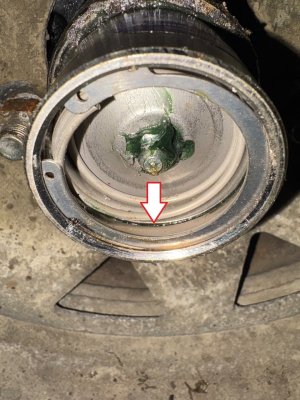
I pumped these under load ie not jacked up so there was no turning the wheel, I am a bit confused on the pic as you can see that light bead of grease indicating she’s getting full but not quite there yet?

I appreciate the insight and I’ll give her a few more pumps and see if we can get that positive pressure
 
I find the biggest problem most times, are the seals fail because of the rust on the axle and than lets water gets in and toasts the bearings. I have had trailers with speedy sleeves on and no buddies and have never had a problem. The sleeve is stainless and saves the seals thus not letting in water and destroying the bearing.
100 percent. I go to Exhaust Masters in Port Alberni to get my bearings, he’s always said throw your bearing buddies away, they cause more problems than solve. Most over grease, instead of checking, repacking.
 
all components are brand new, including the buddies and the 10” drums. Bearings were hand packed properly, light grease on the races etc.

I understand there’s a big cavity to fill, however I was sorta assuming 25ish pumps would’ve been sufficient to see the piston move. It didn’t, and i was just thinking if I continue I’m gonna blow the rear seal.

I pumped these under load ie not jacked up so there was no turning the wheel, I am a bit confused on the pic as you can see that light bead of grease indicating she’s getting full but not quite there yet?

I appreciate the insight and I’ll give her a few more pumps and see if we can get that positive pressure

Packing the bearing is step one, hand packing the hub full of grease is step 2, filling the bearing buddy till it lifts is step 3, driving it around the block to relieve any air bubbles - then topping up the bearing buddy is step 4.

There is a huge volume of space inside the hub that needs to be filled up and it takes a long time with a hand pumped grease gun (don't be tempted to use a battery powered grease gun - you will overfill an blow the seals).

The debate about bearing buddies goes back and forth. I launch in fresh water and they have been bomb proof. I open up the hubs / replace seals every 2-3 years, and the bearings/races have always been fine. For salt water launches, my bet is that every system will fail - especially so if you never open up the hubs to look at it.
 
all components are brand new, including the buddies and the 10” drums. Bearings were hand packed properly, light grease on the races etc.

I understand there’s a big cavity to fill, however I was sorta assuming 25ish pumps would’ve been sufficient to see the piston move. It didn’t, and i was just thinking if I continue I’m gonna blow the rear seal.

I pumped these under load ie not jacked up so there was no turning the wheel, I am a bit confused on the pic as you can see that light bead of grease indicating she’s getting full but not quite there yet?

I appreciate the insight and I’ll give her a few more pumps and see if we can get that positive pressure
IMG_4082.jpgThe arrow points grease leaking by the piston which takes some pressure which happens while you are pumping in grease and the grease has filled most of the void. It does help like others have said to jack up the wheel and spin the wheel to help distribute the grease inside the hub especially on the first fill. The biggest problem I have seen with bearing buddies is that on some trailers the fit into the hub is not to good and you can loose the bearing buddy on the road sometimes so you should carry a spare one or a plain cap.
 
View attachment 123722The arrow points grease leaking by the piston which takes some pressure which happens while you are pumping in grease and the grease has filled most of the void. It does help like others have said to jack up the wheel and spin the wheel to help distribute the grease inside the hub especially on the first fill. The biggest problem I have seen with bearing buddies is that on some trailers the fit into the hub is not to good and you can loose the bearing buddy on the road sometimes so you should carry a spare one or a plain cap.
Bearing buddies need a bit of RTV sealant or loctite when you press/hammer them into the hub. After you hand pack the hub, clean off the lip - then apply a thin coat of sealant to the mating surface of the bearing buddy, then tap it in with a mallet/block of wood.

The sealant isn't listed in the bearing buddy install instructions, but widely recommended. Just don't go overboard and weld it on with sealant - you want to still be able to remove the bearing buddy in a year or two.
 
Last edited:
My reason for bearing buddies is the lack of life I’ve been getting without them. I pull the hub apart annually to re pack and I always end up changing the bearings, races and of course seals because they f’ed.

Not sure what you guys are getting for life but I’d say I’m lucky to get 1500km and ~10 salt water launches before I pull the hub apart and the races are pitted, bearings are corroded etc. Maybe this is Standerd issue but I was hoping for better.
 
My reason for bearing buddies is the lack of life I’ve been getting without them. I pull the hub apart annually to re pack and I always end up changing the bearings, races and of course seals because they f’ed.

Not sure what you guys are getting for life but I’d say I’m lucky to get 1500km and ~10 salt water launches before I pull the hub apart and the races are pitted, bearings are corroded etc. Maybe this is Standerd issue but I was hoping for better.
I spend more money on my trailer than on my boat.
 
My reason for bearing buddies is the lack of life I’ve been getting without them. I pull the hub apart annually to re pack and I always end up changing the bearings, races and of course seals because they f’ed.

Not sure what you guys are getting for life but I’d say I’m lucky to get 1500km and ~10 salt water launches before I pull the hub apart and the races are pitted, bearings are corroded etc. Maybe this is Standerd issue but I was hoping for better.
Put on Speedy Sleeves. Someone else has already recommended it earlier in this thread.
I used to have to replace my bearings and seals yearly, and a couple of times mid season on the side of the highway even with a pre season replacement. It totally sucked. I put on the Speed Sleeves few years ago and haven't had a problem since.
Now if someone could tell how make my drum brakes last more than two seasons.......That would be awsome
 
I have vault hubs on one of my trailers, very happy with them. Supposedly years of maintenance free use, the trailer is 6 years old now without maintenance but hasn’t been used hard for the first few years. I’m going to convert my buddies trailer this spring as he has the same issue as most with having to replace bearings and seals every year.
 
Far more bearings fail from over greasing than under. Grease is manufactured from oil and a "carrier". That carrier can be many things from wax to Lithium. They are cooked together so they with emulsify. When a bearing has too much grease, it will heat up. That heat separates the carrier from the lubricating oil, and the when the oil goes back to it's original liquid form, it runs out of the seals, leaving only the carrier, and the bearing fails.

In over 30 years as a Millwright/Machinist, I've replaced an uncountable number of bearings. There was "wax" left in nearly all of them.

Throw the bearing buddies away, or gift them to someone you despise.

The lips on a bearing seal are designed to let things out, but not let anything in, especially water. If the spindle rusts, it will take out the seal, let water, dirt, and all kinds of nasty contamination in. That will take out a bearing quick as well. A bad seal is...well...it's just bad.

The bearings on my boat trailer lasted from 1984 when the boat was new, until I replaced them this past summer. We only towed that 24' boat about 1600-2000 miles per year, but it adds up. A few minutes of maintenance goes a long way.

 
Far more bearings fail from over greasing than under. Grease is manufactured from oil and a "carrier". That carrier can be many things from wax to Lithium. They are cooked together so they with emulsify. When a bearing has too much grease, it will heat up. That heat separates the carrier from the lubricating oil, and the when the oil goes back to it's original liquid form, it runs out of the seals, leaving only the carrier, and the bearing fails.

In over 30 years as a Millwright/Machinist, I've replaced an uncountable number of bearings. There was "wax" left in nearly all of them.

Throw the bearing buddies away, or gift them to someone you despise.

The lips on a bearing seal are designed to let things out, but not let anything in, especially water. If the spindle rusts, it will take out the seal, let water, dirt, and all kinds of nasty contamination in. That will take out a bearing quick as well. A bad seal is...well...it's just bad.

The bearings on my boat trailer lasted from 1984 when the boat was new, until I replaced them this past summer. We only towed that 24' boat about 1600-2000 miles per year, but it adds up. A few minutes of maintenance goes a long way.
Curious about how many seals and sleeves you went thru in that 40plus years?
 
I took everything apart, greased the bearings, and replaced the inner seal every year. The spindles were strange on that trailer, as the I.D. of the inner race allowed it to slide right off the spindle and the sleeve kept it from spinning. Is kind of hard to explain. Never seen one quite like it, and I've got no idea what brand they were. Never could find a maker stamp/tag, only the weight rating.

I changed the oil in my lower unit the lower unit of my outboard every year on the same day.

Oh yeah, I just sold that old '84 Mercury this last summer, and repowered with a larger Johnson. The guy who bought it was running it this last fall, I know it's still going. I almost hated to see it go, as it was an exceptional engine for a loonng time!. No idea how many hard hours that one had on it. And yes, I stayed with a 2-smoke that is actually older, but with WAY less hours as near as we could tell.
 
Back
Top