Haha you guys need to pay for the Pro Version!
Question:
Gemini, another prop question. Relative to the direction of thrust, which direction would a propellor blade flex under load?
Gemini Pro Response:
This is a great engineering question. When you're running that 150hp hard, the blades aren't static; they are dynamic, "living" components.
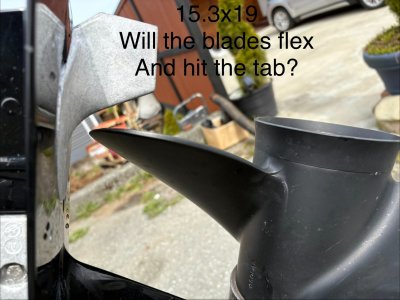
Relative to the direction of thrust, a propeller blade primarily flexes in two distinct ways: **forward** (toward the boat) and **twisting** (usually toward a lower pitch).
### 1. Bending (Forward Flex)
Think of each propeller blade as a **cantilever beam**.
* **The Force:** As the propeller spins and pushes water aft (the thrust), the water pushes back on the blades with equal force (Newton’s Third Law).
* **The Direction:** Because the hub is fixed to the propeller shaft, the tips of the blades flex **forward, toward the bow of the boat**.
This is why "Rake" is so important. Propellers with high rake (like your Enertia) have blades that are already angled aft. This geometry helps counteract some of that forward flex and uses the centrifugal force of the spinning propeller to help keep the blade from "folding" forward under heavy loads.
### 2. Torsional Flex (Twisting)
This is often called **"Dynamic Pitch Loss."**
* **The Force:** The center of pressure on a propeller blade is usually located behind the "elastic axis" (the stiffest part of the blade).
* **The Direction:** Under a heavy load, the trailing edge of the blade tends to peel back or "wash out." This causes the blade to **twist toward a lower pitch**.
If you have an aluminum prop, this flex is significant. As you add throttle, the blade flattens out, effectively turning a 17P prop into a 16P or 15P prop exactly when you need the "grip" the most.
### Why Your "Enertia" Matters Here
This is the primary reason you paid a premium for the **Enertia** and its **X7 Alloy**.
1. **Stiffness:** Stainless steel is roughly **three times stiffer** than aluminum. It resists that forward bending and torsional twisting much better.
2. **Thinness:** Because the X7 alloy is so strong, Mercury can make the blades thinner. Thinner blades have less "frontal area," which reduces drag and allows the prop to slice through the water more efficiently.
3. **Consistency:** Because the Enertia doesn't "wash out" (lose pitch) under load like an aluminum prop, it maintains its 17P or 15P geometry even when you’re hammering it out of the hole or climbing a big swell.
### The "Cupping" Factor
You’ve probably noticed the "lip" on the trailing edge of your Enertia blades—that's the **cup**.
The cup's job is to act like a structural reinforcement and a "water-catcher." It helps the blade maintain its grip and reduces the amount of "pitch loss" that happens when the trailing edge tries to flex.
**Summary for the Shop:**
* **Bending:** Tips move **forward** (toward the boat).
* **Twisting:** Trailing edge peels back (**decreasing effective pitch**).
* **Result:** High-quality stainless props (like yours) minimize this, leading to better "hook up" and more consistent RPMs.
Are you asking because you’re seeing some unusual wear patterns on the blades, or maybe some cavitation burn on the suction side?