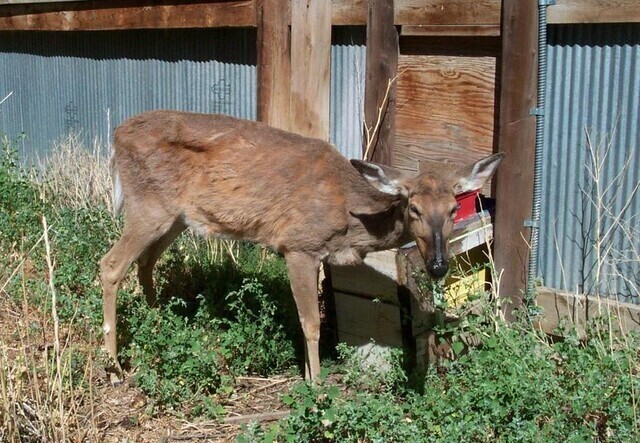
Potential chronic wasting disease detected in Okanagan deer

IronNoggin

Well-Known Member

Potential chronic wasting disease detected in Okanagan deer​

A potential chronic wasting disease case has been detected in an Okanagan deer.

The province is now responding to the potential case in a male white-tailed deer harvested east of Enderby.

CWD is an infectious and fatal disease affecting species in the cervid family, such as deer, elk, moose and caribou.

Initial testing by the provincial animal health laboratory may indicate CWD in the deer sample. The sample has now been submitted to the Canadian Food Inspection Agency (CFIA) for further testing. Results are expected by early December.

The province will update the public if the CFIA confirms the sample to be positive for CWD.

The B.C. Wildlife Federation is asking hunters across the province and especially in the Okanagan to submit samples from any deer they harvest to a provincial drop-off location. Sample submissions are currently mandatory in management units in the Kootenays. In other parts of B.C., submission is voluntary.

“It’s really important that hunters continue to hunt and to submit heads for testing, even outside the mandatory submission zone in the Kootenays,” said B.C. Wildlife Federation executive director Jesse Zeman. “The more data we collect the better we can manage the situation.”

This is the first potential detection in the Okanagan and the first identified outside B.C.'s existing CWD management zone in the Kootenay region.

As part of B.C.'s Surveillance and Response Plan for CWD, the provincial wildlife veterinarian has assembled an incident management team made up of provincial and First Nation partners to prepare for potential next steps ahead of the CFIA's test result.

The B.C. Wildlife Federation says hunters are essential to this process.

"Without hunter involvement, the scale of surveillance and management required to respond to CWD would not be possible," says an email from the BCWF.

There is no direct evidence that the disease can be transmitted to humans, and there have been no cases of the disease in humans.

However, to prevent any potential risk of transmission or illness, Health Canada and the World Health Organization recommend that people not eat meat or other parts of an animal infected with CWD.

To date, there have been six confirmed cases of CWD in B.C.

 
Just vaccu packed all my whitetail sausage today. Our deer tested negative. Took about 6 weeks for results.
 

Attachments

  • PXL_20251125_174451505.jpg
    PXL_20251125_174451505.jpg
    266.8 KB · Views: 10
  • PXL_20251125_190939039.jpg
    PXL_20251125_190939039.jpg
    169.7 KB · Views: 10
  • PXL_20251125_194158331.jpg
    PXL_20251125_194158331.jpg
    317.6 KB · Views: 10
Just vaccu packed all my whitetail sausage today. Our deer tested negative. Took about 6 weeks for results.
How do you go about getting it tested?
 

No chronic wasting disease found in tested Enderby deer​

A potential case of chronic wasting disease (CWD) in a harvested white-tailed deer east of Enderby has been ruled negative.

CWD, sometimes called zombie deer disease, is an infectious and fatal disease affecting cervids such as deer, elk, moose and caribou. The BC Wildlife Federation announced the possible Enderby case last month.

On Monday, the Ministry of Water, Land and Resource Stewardship said the initial screening test by the B.C. Animal Health Centre showed a "non-negative" finding for the sample, meaning the disease could not be ruled out. That sample was then sent to a Canadian Food Inspection Agency lab for deeper testing.

Three different testing methods all were negative for CWD.

“While this result is negative, CWD remains a serious concern in B.C. and does not change the confirmed presence of CWD within the provincial CWD management zone in the Kootenay region,” said the ministry in a news release.

Hunters are strongly encouraged to submit samples from deer, elk and moose harvested anywhere in B.C. to help determine where the disease is present and to detect new cases as early as possible.

“There is no direct evidence that CWD can be transmitted to humans, and there have been no reported cases in people,” said the ministry.

“However, to prevent any potential risk of transmission or illness, Health Canada and the World Health Organization recommend that people do not eat meat or other parts of an animal infected with CWD.”

CWD causes a fatal neurological condition in cervids that leads to extreme weight loss, stumbling, listlessness, and behavioural changes like losing fear of humans, hence the "zombie" nickname. There is no cure.

To date, there have been six confirmed cases of CWD in B.C., all within the Kootenay region.


No chronic wasting disease found in tested Enderby deer​

A potential case of chronic wasting disease (CWD) in a harvested white-tailed deer east of Enderby has been ruled negative.

CWD, sometimes called zombie deer disease, is an infectious and fatal disease affecting cervids such as deer, elk, moose and caribou. The BC Wildlife Federation announced the possible Enderby case last month.

On Monday, the Ministry of Water, Land and Resource Stewardship said the initial screening test by the B.C. Animal Health Centre showed a "non-negative" finding for the sample, meaning the disease could not be ruled out. That sample was then sent to a Canadian Food Inspection Agency lab for deeper testing.

Three different testing methods all were negative for CWD.

“While this result is negative, CWD remains a serious concern in B.C. and does not change the confirmed presence of CWD within the provincial CWD management zone in the Kootenay region,” said the ministry in a news release.

Hunters are strongly encouraged to submit samples from deer, elk and moose harvested anywhere in B.C. to help determine where the disease is present and to detect new cases as early as possible.

“There is no direct evidence that CWD can be transmitted to humans, and there have been no reported cases in people,” said the ministry.

“However, to prevent any potential risk of transmission or illness, Health Canada and the World Health Organization recommend that people do not eat meat or other parts of an animal infected with CWD.”

CWD causes a fatal neurological condition in cervids that leads to extreme weight loss, stumbling, listlessness, and behavioural changes like losing fear of humans, hence the "zombie" nickname. There is no cure.

To date, there have been six confirmed cases of CWD in B.C., all within the Kootenay region.

Good to know. Thanks for posting
 
Back
Top