Electronics

  • Thread starter Thread starter Loghauler
  • Start date Start date
L

Loghauler

Guest
Have 18 ft boat and will want a fish finder/gps unit and am wondering about experience with various units and displays
Boat is fibreglass with outboard if it matters and will fish west coast would like to go offshore as well
 
Have 18 ft boat and will want a fish finder/gps unit and am wondering about experience with various units and displays
Boat is fibreglass with outboard if it matters and will fish west coast would like to go offshore as well
Hard to go wrong with any Lowrance products to suit your budget. Elite 7s are rock solid with bright screen and good maps.

I bought a garmin Echomap 74CV which will arrive tomorrow. Got a good deal, otherwise I'd be outfitting for Lowrance as well.

From what I've read, downscan/sidescan isn't as useful in the deep salt and CHIRP is the way to go.
 
I have an 18’er and a Lowrance HDS 7 gen 2 with p66 transducer. It’s great. I can see my downrigger balls. But I catch fish when I can’t see fish on the sounder so I’m more interested in seeing the bottom instead of seeing fish on the sounder. Seeing fish doesn’t mean you will catch fish
 
Agreed with a above post. Getting an accurate depth, and seeing the bait is what I’m about.
The map detail is also important to keeping cannonballs and this is a here my older elite 7 lacks a bit. Still not sure if it’s a Navionics issue or what but I’m going to upgrade if I can’t figure it out.
 
There is debate as to which brand has the best technology. I am happy with Lowrance and have experience with both fixed mount chart plotter/sounders and also handheld color chart plotters. I see no reason to change brands, especially as I am very familiar with the Lowrance interface which is similar across devices and models and don't want to start over learning a completely new interface from scratch. So when it is time for replacement, I will stick with Lowrance.
 
If you are expecting to spot each salmon that swims under your boat, I think you’ll be disappointed.

I find that salmon don’t mark very well even with “high end” transducers and sonar. They don’t have much of a swim bladder, so the returns from salmon are pretty weak unless they are right in the “cone” and your sonar is tuned just right.

In comparison, rockfish and baitfish light up like roman candles and are very easy to identify. I think a lot of times when people say they “marked lots of fish”, they most likely saw something else - debris in water, weeds, etc.

Lots of times I’ll hook fish without having a definitive mark on my screen beforehand (that’s running a 1KW B175HW transducer, with the gain turned up as far as I can go before the clutter gets too loud). Sometimes it happens where you’ll see a salmon swim up and bite the gear which is cool, but I don’t expect to see that every time.

I’m most interested in the following info from my sounder in decreasing importance:
1) depth (if fishing structure as charts aren’t always 100% accurate)

2) depth of bait

3) depth of salmon. They don’t mark well, but after a while you learn what to look for and can see them if you get a good return.

FWIW, I don’t find it particularly useful to see my gear on the screen, that’s what the counter on the downrigger is for.

 
I’m just wondering as I’ve never done it or seen one in action do you see the fish your targeting on the screen even if you don’t see the hit on your rig or is it just a case of putting the rig in the right spot and time for a feeding time ie the bite is on
Sometimes you may see the fish that ends up hitting your bait/lure, but not that often. The big factor is the sounders operating frequency. Mine is switchable between 50 and 200 kHz. Most who have sounders that use these frequencies use 200 kHz for salmon fishing as it will give you the best fine detail both to see fish and bottom detail. The trade-off is that the cone is very small compared to 50 kHz which has a much larger cone. In short, at 200 kHz you will get nice clear arches of salmon and show even very small one and even bait size fish and krill, but only if they are right under the transducer, which most of the salmon that see and hit your lure are not. I can often make a fairly accurate assessment as to the size of the salmon by the size of its arch in relation to its depth, and if it is very large and shallow, it may have some red in the arch on the display, not just black.

So why not use 50 kHz? Because the detail is terrible, and you may not even see a salmon even if your transducer runs right over it. So why have the low frequency option? Because it can see the bottom at much greater depth and beyond the point where, at 200 kHz, you may lose bottom lock. For us, we always salmon fish using 200kHz, looking for salmon, bait/krill at specific depths. Overall having a very clear and accurate representation of the bottom with fine detail is every bit as important as seeing fish. Sometimes you want to bring up your ball to clear a reef and then drop back down as soon as you are over to find a salmon hiding close to it out of the current. Sometimes at 200 kHz we can see kelp and weed growing off the reef not just the rock bottom, so we know to bring up the ball to not just clear the reef but also the kelp/weed above it.
Different sounders may offer choices of different frequencies, which may have their own advantages and disadvantages. Basically, the higher the frequency the less area is covered, but the detail is better.
 
Last edited:
If you are into jigging, you can see the fish hit sometimes.
When trolling, the gear is too far behind the boat usually to see the cannonball and then 15’ or so back to your flasher plus 5’ more to your lure. Fish often hit from behind so you don’t see them follow or hookup.
 
Have 18 ft boat and will want a fish finder/gps unit and am wondering about experience with various units and displays
Boat is fibreglass with outboard if it matters and will fish west coast would like to go offshore as well

Thanks for starting this thread Loghauler. I'm new to fishfinders too and appreciate the knowledge dispensed so far. I'm a new owner of a Garmin echomap 72 cv....and it's almost all greek to me.

I was wondering, do most of you use the "traditional" display?

If you're fishing close to the bottom how do you navigate without getting hung up? Do you keep the chart open (combo screen) and follow a contour line?
 
Thanks for starting this thread Loghauler. I'm new to fishfinders too and appreciate the knowledge dispensed so far. I'm a new owner of a Garmin echomap 72 cv....and it's almost all greek to me.

I was wondering, do most of you use the "traditional" display?

If you're fishing close to the bottom how do you navigate without getting hung up? Do you keep the chart open (combo screen) and follow a contour line?
If you are fishing close to bottom and there are
pinnacles then you will need to have a partner working the riggers while you give instructions.

Or if you are on a flat Sandy bottom then you can drop the ball to the bottom, bring it up a few feet and follow a contour line.

You’re taking to a guy who lost 11 balls in one year a few years ago and now zero lost in the last two years. I’m an expert at the subject!
 
I have a Gen 3 Lowrance with a total scan transducer that I have tilted up a notch so I can see my down rigger balls down to 100 to 120 ft on 200 khz

Nothings more awesome than seeing a streak coming up from the bottom towards the balls then the rod pops off
 
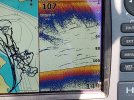
Sonar shows salmon fine when they're really stacked: Osoyoos sockeye last year. And these fish are small, they average just 4 lb. Super low troll speeds, 1.0-1.5 mph, so the cannonballs are visible at 65 and 80 ft.

20200731_105337.jpg
 
I've been running garmin and love them... EchoMaps unit was just a joy to use. Wont' be long till I get another one. One down fall is trying to update the mapping chip on them though. My computer or my girlfriends isn't compatable with the nav chip and couldnt' update unfortunatlly yet. No fault of the unit just something to be aware of if you're buying mapping cards.
 
Smallest size that can handle splt screen viewing is 7". Even then you'll mostly want to run either full screen sonar or full screen GPS, depending what you're doing. So you either buy a larger screen unit up front or at least get a 7" in a model that has networking capability so you can add a second unit later.
 
Last edited:
I’m guessing my learning curve is going to be interesting as well
Just boating safely is a chore in some spots compared to an interior lake and now throw in electronics downrigger and not to mention a fish on ! Gonna be a blast even if it’s a small one
Should tell everyone my story of the giant monster that got away but that’s a different thread lol
So fishing with electronics and especially charts/plotters makes the difference
Kinda makes sense but this fishing hobby is more like a sickness lol
Imagine all the dollars saved if fishing stopped at the grocery store
Now on to charts gps and plotters
Tell me more master
Aside from the wealth of info you'll get from the members here, many of us will be willing to assist in your first few outings to establish / build confidence. It's amazing what a case of beer will get you here.

It's easy to learn but, of course, nearly impossible to master. But that's the fun of it!

7" is what I have on my boat which is sufficient for either sonar or charts, but not idea for both at the same time . While trolling I have my phone in a holder with charts so the sounder is dedicated sonar.
 
I have guided and fished extensively the past 10 years using Lowrance units. If I was you and starting out I would buy a 7” Lowrance HDS unit or a bit cheaper Elite unit and an Airmar P66 transducer.
I run split screen all the time and use the sounder side more than the chart plotter side as bait and bottom are critical to catching chinooks. The touch screens are nice to navigate with.
Just my opinion but after years of Furuno on commercial boats the Lowrance is simple yet effective.
 
Interesting topic - I have electronics a few years old, a Lowrance Mark 5x sonar and Standard Horizon GPS chartplotter. I find them both very useful. I can sometimes see salmon on the sonar but not always. I say this because I was jigging about 20 odd trips this summer and sometimes I would see what I thought were salmon where I thought my gear hopefully was then immediately get one on. Most of the time I did not see fish before they hit. What I do see, I think 100%, is baitfish. Seeing them drives the fishing for me jigging, trying to be just above or at the edge. The density and distribution is also noticeable and can give you an idea if they are being fed on and pressured.
I sometimes think of upgrading to a newer sonar as it would be very interesting to see one that consistently showed salmon etc.
I used to use a little hummingbird sonar when trout stillfishing with streamers and nymphs in Manitoba. In the shallow water (less than 20') it often showed fish that would hit a fly when covered (obviously the most fun is casting to fish you can see).
 
lowrance are nice units with the p66. you can only get the p66 with the xsonic 9 pin so you need to buy the adapter 9 to 7 pin for $50. stock lowrance transducers are terrible the 50khz and the 83khz. they work but fail in like 2 years or so. so the p66 is the needed transducer.
 
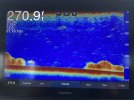
I know this is not for everyone as pretty expensive but wanted to show what this can look like.
This is an Airmar B175HW 1KW Chirp transducer connected to a Garmin 1242xsv. I really like the whole setup.
You can aslo save different sounder preset configs like deep fishing, shallow fishing, cruising, etc.
When cruising I need to change frequency to 150khz only to hold bottom so I have that as a preset.

Kitty Coleman. “The Hump” lots of fish and bait but mostly shakers but arches all the way down to bottom.

E7DD72BA-E087-487D-832D-30E53989AE05.jpeg


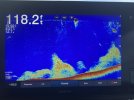
T10 between North Arm and Sandheads.
Lots of bait but only a few arches and probably Pinks or shakers.
I think in this case after a few passes it helped us decide to move elsewhere.
AB188CAA-47D1-4EB9-8738-8F7CFF6A8BBA.jpeg
 
Back
Top