


You are using an out of date browser. It may not display this or other websites correctly.
You should upgrade or use an alternative browser.
You should upgrade or use an alternative browser.
Christmas 2025
- Thread starter IronNoggin
- Start date
IronNoggin
Well-Known Member
The Carol That Paused a War

In the Bible, there are many stories of angels speaking to men, warning them, guiding them, and comforting them, but there was only one time—one time only—when men heard angels sing. It was on the night of Christ’s birth into our world that angels sang “glory to God” and “peace on earth.” Just a handful of common people, common shepherds, were chosen to hear that song.
Now, there are hundreds, even thousands, of Christmas songs, carols, cantatas, and oratorios, conceived and sung by mortal men, celebrating the miracle that took place so many centuries ago. One of the most beautiful and most loved is “Adeste Fideles,” or “Oh Come, All Ye Faithful.”
Unlike a government, a song knows no borders, passing freely from one country to another. Sometimes they even cross front lines and trenches in the time of war.
A Christmas Eve Long Remembered
A remarkable and astonishing event took place during Christmas 1914. Weeks before, Pope Benedict XV had asked all the warring powers for a Christmas truce, but the monarchs with their ministers, safe among their tapestries and chandeliers, refused to allow the killing to stop for even one day.
However, on Christmas Eve, all along the Western Front, the men in the trenches heard carols sung by their so-called enemies and sang their own songs in reply. They were, in fact, the very same songs, but in a different language. About two-thirds of the armed forces, longing for home and grieving their fallen comrades, spontaneously called their own truce.
A British soldier, Graham Williams, recalled:
“First the Germans would sing one of their carols and then we would sing one of ours, until when we started up ‘O Come, All Ye Faithful’ the Germans immediately joined in singing the same hymn to the Latin words ‘Adeste Fideles.’ And I thought, well, this is really a most extraordinary thing—two nations both singing the same carol in the middle of a war.”
As morning broke along the front line, weapons were set aside and expressions of goodwill were spoken among those men who had been shooting at each other a day before. Even gifts of food and cigarettes were exchanged, and both sides were able to bury the dead who had lain in the trenches and on the fields.
Another British soldier remarked, “If we had been left to ourselves there would never have been another shot fired.”
One is reminded of Frederick the Great saying, “If my soldiers were to begin to think, not one of them would remain in the army.”
At Christ’s birth, angels sang “peace on earth”—not to kings, but to the common people. Centuries later, those common soldiers in the trenches did not hear angels, but they heard their own brothers sing songs of peace and goodwill. Perhaps peace lies only in their hands.
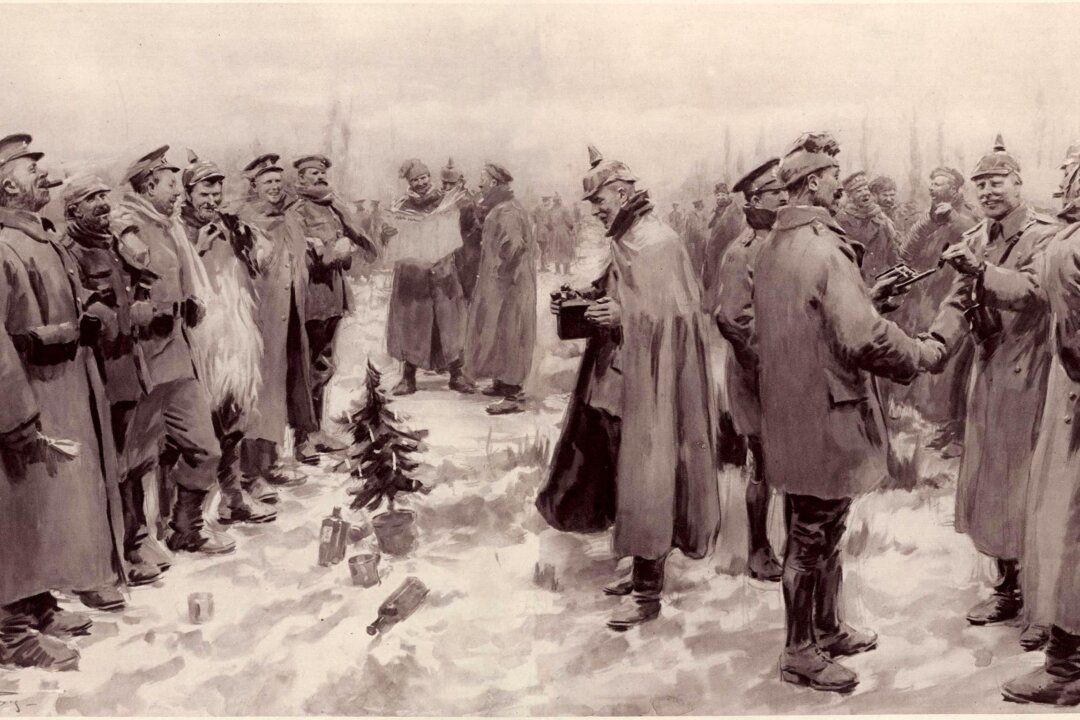
The Carol That Paused a War
On a frozen Christmas in 1914, singing soldiers brought peace and goodwill to a battlefield.
IronNoggin
Well-Known Member
IronNoggin
Well-Known Member
IronNoggin
Well-Known Member
IronNoggin
Well-Known Member

Newf
Crew Member
Merry Christmas everyone and wish you all good health and happiness through the Christmas Season and the New Year. Very thankful to all who make this a great forum by sharing your knowledge and experiences.
I did this a few times over the years in Fort Mac. I don’t miss it at all.

 www.facebook.com
I did this a few times over the years in Fort Mac. I don’t miss it at all.
9.3K reactions · 1.1K shares | Besides running, tossing boiling water into the air is my favourite -40°C activity! 🤩 Have you tried it before?❄️❄️ | Shailyn Drukis
Besides running, tossing boiling water into the air is my favourite -40°C activity! 🤩 Have you tried it before?❄️❄️
www.facebook.com
IronNoggin
Well-Known Member


John Ingram
Well-Known Member
A great artist was lost today

scott craven
Well-Known Member
We've been listening to Chris Rea since the 80's.
He didn't ever see mainstream, but his music was incredible.
RIP
He didn't ever see mainstream, but his music was incredible.
RIP

PEETZcanada
Well-Known Member
We're not too far away now...I just wanted to stop in and wish you all a Very Merry Christmas and Happy Holidays. I am also wishing each and everyone of you an amazing New Year in 2026. I am so grateful for all the support and kind words of encouragement that I have received oover the past few years. I appreciate it all greatly. Have a happy, jolly, fun and safe time with family and friends. Enjoy all that you have and most of all know that everything that you ever need already surrounds you. It's yours, you only have to reach for it, work for it, stay positive and in the light always.
Take care everyone...
Take care everyone...
Attachments

IronNoggin
Well-Known Member
IronNoggin
Well-Known Member
The Bible’s Star of Bethlehem May Have Been a Comet, Analysis of Ancient Records Suggests
An odd star brightened for more than 70 days in 5 B.C.E., according to a Chinese text. The object may have been a comet that looked like it rose, then stood still over Bethlehem
Elihu Vedder's 19th-century painting "Star of Bethlehem" Elihu Vedder, Public domain via Wikimedia Commons“After their audience with the king, [the wise men] set out,” reads chapter two of the Book of Matthew. “And behold, the star that they had seen at its rising preceded them, until it came and stopped over the place where the child was.”
This is the biblical story of the Star of Bethlehem, the celestial object that seemingly guided three wise men, or magi, to baby Jesus. As far as stars go, however, this one behaved rather strangely, which has made it difficult for researchers to identify it as an astronomical event.
Some hypotheses include aligning planets, meteors and exploding stars, but these phenomena don’t rise and suddenly stop as the Star of Bethlehem did. “This has often led to one of two conclusions: to assume the star was miraculous in nature, or to consign the entire story to the category of religious myth,” writes Mark Matney, a NASA planetary scientist, in a study published December 3 in the Journal of the British Astronomical Association.
But an analysis of ancient astronomical records may point to another possible explanation: a comet.
“My goal here was to not prove that this was the Star of Bethlehem but to show that the idea that no astronomical object can behave this way—we can no longer say that,” says Matney, who conducted the work independently of NASA, to FOX 32 Chicago’s Anita Blanton.
He came up with the idea as a college student. Back then, he worked at a planetarium, where a Christmas sky show explained that no astronomical object could act as the biblical star did, Matney tells Scientific American’s Meghan Bartels. From an earthling’s point of view, every celestial body rises in the east and sets in the west—nothing should ascend in the southern sky and come to a standstill, as the Star of Bethlehem was described doing.
“I remember sitting there saying, ‘Oh, I know one that could do that,’” he tells the outlet.
A comet that takes hundreds to millions of years to orbit the sun might. Called long-period comets, these objects are thought to come from the Oort Cloud—a theoretical shell surrounding the solar system that contains icy bodies.
Quick fact: About the Oort Cloud
Astronomer Jan Oort proposed in 1950 that some comets come from the Oort Cloud. It’s thought to reside in the most distant regions of the solar system, approximately 100 times farther from the sun than Pluto is.
If a bright comet cozied up to Earth at just the right speed, direction and distance, it could look like it’s frozen in time for a little while, Matney tells FOX 32 Chicago.
So, he scoured ancient astronomical texts in search of such an event. A historical account from China documented a strange star that appeared in the year 5 B.C.E. and glowed for more than 70 days. Constructing an orbit for this odd star—which Matney suspects was a comet—resulted in a plausible explanation for the Star of Bethlehem. “This comet could have moved in such a way as to appear to ‘go before’ someone traveling from Jerusalem to Bethlehem and then ‘stop’ nearly overhead for about two hours,” he writes in the paper.
But the Chinese source is potentially misleading, Ralph Neuhäuser, an astrophysicist at Friedrich Schiller University Jena in Germany who was not involved in the study, tells Scientific American. “The older the record, in general, the less information is left,” he says.
Matney agrees but contends that ancient Chinese records have “proven to be, in general, pretty accurate” regarding astronomical events, including stellar explosions and flybys of Halley’s comet, he tells FOX 32 Chicago.
Still, he says, “until we have corroborating evidence from other observers from the ancient world, I think this remains in the category of plausible but not proven.”

The Bible’s Star of Bethlehem May Have Been a Comet, Analysis of Ancient Records Suggests
An odd star brightened for more than 70 days in 5 B.C.E., according to a Chinese text. The object may have been a comet that looked like it rose, then stood still over Bethlehem
IronNoggin
Well-Known Member

IronNoggin
Well-Known Member
IronNoggin
Well-Known Member
IronNoggin
Well-Known Member
IronNoggin
Well-Known Member
IronNoggin
Well-Known Member
Snowing like hell & sticking here in Port!
Was hoping for a White Christmas, but sincerely doubted it would happen.
Sometimes we actually get what we hope for!!
Merry Christmas Folks!
Was hoping for a White Christmas, but sincerely doubted it would happen.
Sometimes we actually get what we hope for!!
Merry Christmas Folks!
Similar threads
- Replies
- 0
- Views
- 466

- Replies
- 10
- Views
- 1K


- Replies
- 108
- Views
- 4K


