

IronNoggin
Well-Known Member
The ‘Wolf Moon,’ the First Supermoon of 2026, Will Form a Conjunction With Jupiter—What to Know

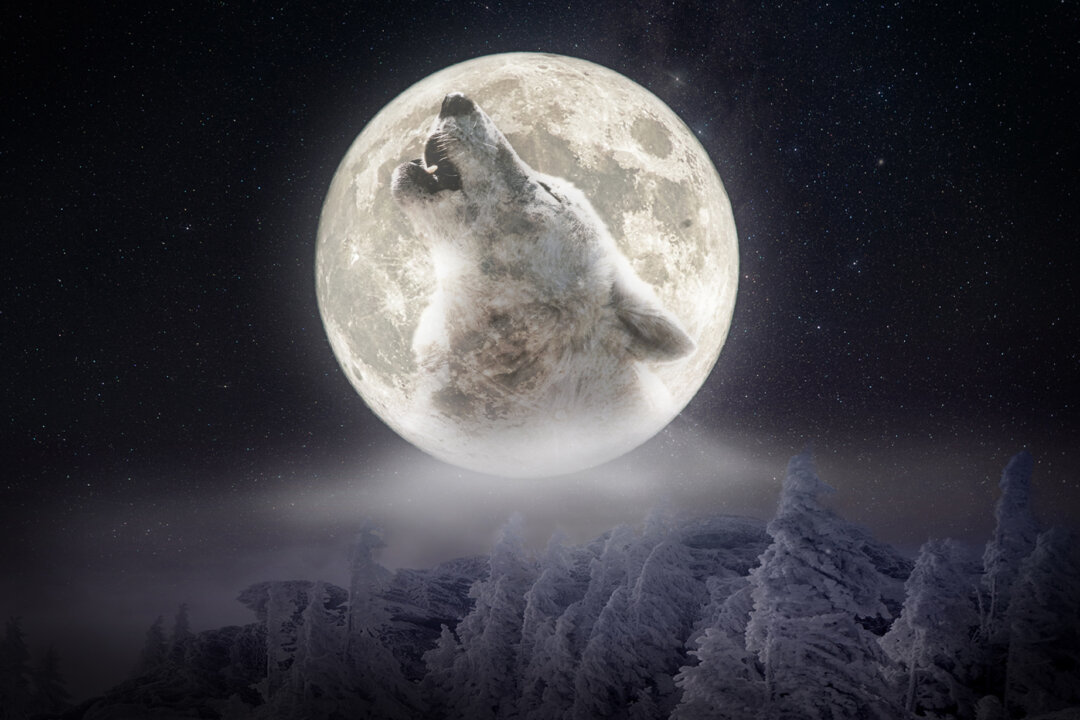
This season, when howling wolves reach their yearly crescendo, the first full moon of 2026 won’t disappoint. It will soar higher in the sky than it will for the rest of year and will loom extra large, because it will be a full “Wolf” supermoon.
It may sound supernormal, but astronomers know that supermoons are astronomical events that happen when the moon draws in closer to Earth. Meanwhile the “Wolf Moon” is a name from folklore. On Jan. 3, both events will coincide when the moon reaches technical fullness at 5:03 a.m. Eastern Time. And there’s more in store: a lunar-planetary conjunction and a meteor shower.
What looks like a bright star shining beside the full moon will actually be the biggest planet in the solar system, Jupiter. Incidentally, an observer might also notice some shots of light darting from the constellation Gemini, as the Geminids meteor shower—one of the year’s best meteor showers—will also overlap the full Wolf Moon next month.
With all this talk of celestial conjunctions and supermoons, what’s next? Earthquake predictions? Fire and brimstone? No, despite the auspicious-sounding jargon the space activity surrounding the full Wolf Moon in 2026 isn’t that extraordinary. Science can dispel the mysticism.
A Full ‘Wolf’ Supermoon
Next month, the full moon’s larger size won’t be an illusion. The moon literally will come closer to Earth than usual so will seem bigger. It will come 18,000 miles closer than average, in fact, which can only happen because its orbit isn’t round but rather elliptical, and its distance from Earth varies. When a full moon occurs near its closest point to Earth, its perigee, astronomers call that a perigean moon—or supermoon.
The the full Wolf Moon in 2026 will outshine average full moons by up to 16 percent in brightness and appear up to 8 percent larger, though casual observers probably won’t spot the difference unless they’re really paying close attention. The distinction is subtle but not insignificant.
Scenes like this supermoon are hardly epochal events, however. They happen roughly three to four times per year—every supermoon season. The full moon cycle and moon’s distance cycle line up for a supermoon season every 13–14 months, when the moon’s elliptical orbit brings it close to Earth for several consecutive full moons.
A Conjunction With Jupiter and Shooting Stars
Planets and moons constantly align and conjoin every year and have since the dawn of time. The fact that Earth, the sun, the moon, comets, asteroids, and the planets all orbit along the same celestial plane (albeit imperfectly) makes it inevitable that they'll line up and overlap on a regular basis, and not infrequently. This year, the gas giant Jupiter will happen to be in the neighborhood when the full Wolf Moon occurs.
When the planet and moon finally fall into sync they won’t need to overlap visually to qualify as a “conjunction” in the eyes of astronomers. Space is 3-D, and viewpoints vary infinitely, and while these objects’ orbits are quite similar they’re never exact. So, since a perfect conjunction is all but impossible, scientists allow some leeway, defining it as two bodies appearing close to each other, rather than overlapping, eclipsing, or occulting. The moon and planet Jupiter will get quite close, less than 4 degrees apart from each other.
Meteor showers like the celebrated Geminids, too, aren’t anomalous or rare. They start as streams of debris in space that gets in Earth’s way as it traverses around the sun. They'll add a sprinkle of fireworks to the night sky for the full Wolf Moon next month, though the bright moonlight is likely to wash out most of the shooting stars.
Howling at The Moon?
While some Native American tribes and our Colonial ancestors invented the name Wolf Moon to denote wolves howling during the calendar month of January, their explanation might be based on myth. Wolves do howl more at night during winter, though the old assumption was, apparently, that they were howling because of hunger or the season’s scarcity. Scientists now think otherwise, assigning the behavior more to wolf communication, coordination for hunting, and the reinforcement of social bonds between pack members. Yet Wolf Moon somehow seems fitting; we still use it today.
Similar moon names have also popped up in North American and European culture. Had we not chosen Wolf Moon, it could have been any number of other animals typically associated with January by native tribes. There’s the Goose Moon of the Tingit people of the Pacific northwest, and the Bear Moon of the Potawatomi from the Great Lakes region.
The name Stay Home Moon of the Cherokee seems like good advice for people hearing wolves howling outdoors on cold nights, while it sounds just as fitting today as we glance outside at the frightful weather.