
Stripes in power trowelled basement slab

Boss

New Member
Hi

Seeking advice from any concrete experts here. During my home renovation I had a new concrete slab poured in my basement. The concrete was finished with a power trowel. The plan was to go with concrete as my finished floor.

My contractor covered the newly poured concrete floor with ram board and continued on with their work in the basement. It’s been about 12 months since the concrete was covered by the ram board and I have just begun pulling up the ram board to apply a finish of some kind.

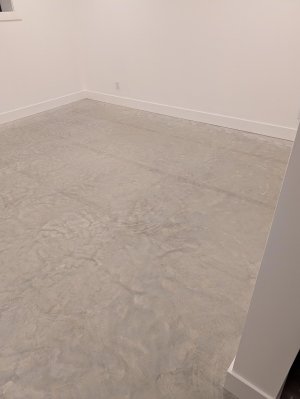
When I pulled up the ram board I see that there is a darker stripe where the ram board was overlapped. Not sure what to do here. Now that the floor is exposed to light do you think the "stripes" fade over time? I don't want to put down some type of finish/sealer if its just going to lock in the discoloration. Any suggestions of how to fix this?

Thanks Rob
 

Attachments

  • gym floor.jpg
    gym floor.jpg
    113.2 KB · Views: 76
Hi

Seeking advice from any concrete experts here. During my home renovation I had a new concrete slab poured in my basement. The concrete was finished with a power trowel. The plan was to go with concrete as my finished floor.

My contractor covered the newly poured concrete floor with ram board and continued on with their work in the basement. It’s been about 12 months since the concrete was covered by the ram board and I have just begun pulling up the ram board to apply a finish of some kind.

When I pulled up the ram board I see that there is a darker stripe where the ram board was overlapped. Not sure what to do here. Now that the floor is exposed to light do you think the "stripes" fade over time? I don't want to put down some type of finish/sealer if its just going to lock in the discoloration. Any suggestions of how to fix this?

Thanks Rob
Concrete has cured at different rates the stripes will fade a little over time but will most likely be there forever
If they taped the joints on the ram board even worse
 
Thanks Nootka.
The ram board joints were taped. Any suggestions for any fix? If I put down a stain of some kind will it cover over the stripes or make it look worse?
 
This is a pretty common issue, just uneven curing and staining from Ram Board overlaps. Here’s why the stripes showed up: over the past year, the overlapped areas stayed damp longer than the exposed spots, so the concrete dried unevenly and darkened where moisture lingered. Sometimes tape or adhesives from the overlaps can slightly stain or change the surface texture. Plus, with a power-troweled finish, even small curing differences stand out. It’s purely cosmetic, not a defect. I would not recommend sealing it as it will lock in the stain


Perfect explanation Casper, a stain can be used to blend out the stripes as the stain will naturally stain deeper in some areas and less in other due to the perosity of the concrete and the density of the finish
Don’t seal or use an acid to clean the concrete prior to the stain
 
Thanks Nootka and Casper. Any recommendations for type/brand of stain to look for? There seems to be water based and acid?
 
They used the wrong tape and covered it too quick. You really need to give it a couple weeks uncovered and spotless before trying to cover it. They make breathable tape for this exact purpose. No matter what you do though, it's never going to be perfect, it's concrete. I agree that some kind of acid or stain gives it a more modeled look and makes you notice the imperfections less. You can even give it some cut lines to break it up further. Once all of your furniture goes in there it all just blends together anyway. At least it's not orange like all of the concrete in my house turned into. Bad batches at Ocean with some new fly ash supplier or some BS like that. There was a couple year stretch where they tried to convince the world that orange was the new grey. What a nightmare.
 
If you saw cut the slab you can do a decorative pattern like large tiles and then use a good grout to fill the saw cut to give it a great look.
My preference is to saw cut a boarder in (6”-8”) away from all the walls in the basement then cut in 3 foot tiles at a 45 degree angle. Stain,clean,grout and seal
 
They used the wrong tape and covered it too quick. You really need to give it a couple weeks uncovered and spotless before trying to cover it. They make breathable tape for this exact purpose. No matter what you do though, it's never going to be perfect, it's concrete. I agree that some kind of acid or stain gives it a more modeled look and makes you notice the imperfections less. You can even give it some cut lines to break it up further. Once all of your furniture goes in there it all just blends together anyway. At least it's not orange like all of the concrete in my house turned into. Bad batches at Ocean with some new fly ash supplier or some BS like that. There was a couple year stretch where they tried to convince the world that orange was the new grey. What a nightmare.
Even without any tape at all, overlaps in the dry sheathing result in less moisture movement than in the single thickness field areas. In theory, you should get an even cure if the sheets are butted together and held with breathable tape, but it's still concrete doing concrete things. As you say, best policy is to leave it completely uncovered and undisturbed for a couple of weeks. Double that if the concrete is pigmented.

If a client wants to have concrete as finished floor, I pretty much insist on it being done at the finished flooring stage, ie, after drywall, paint, tile and cabinetry. If necessary, place a structural slab on grade first as a work platform and allow height for finished slab later.
 
Even without any tape at all, overlaps in the dry sheathing result in less moisture movement than in the single thickness field areas. In theory, you should get an even cure if the sheets are butted together and held with breathable tape, but it's still concrete doing concrete things. As you say, best policy is to leave it completely uncovered and undisturbed for a couple of weeks. Double that if the concrete is pigmented.

If a client wants to have concrete as finished floor, I pretty much insist on it being done at the finished flooring stage, ie, after drywall, paint, tile and cabinetry. If necessary, place a structural slab on grade first as a work platform and allow height for finished slab later.
It's the only way to go now for sure. Clients don't get the fact that those pictures on Instagram don't show all of the cracks and imperfections the same as in person. Concrete floors were always meant to be a durable and cheaper with the natural character shining through. I don't even bother with them anymore unless the client wants a topping like Terrazzo or micro cement done after the fact as you said. There are also lots of really nice large format "concrete looking" tiles that give a way more consistent look and don't disrupt the workflow like trying to baby polished concrete.
 
Back
Top